Chapter content · Overview diagram
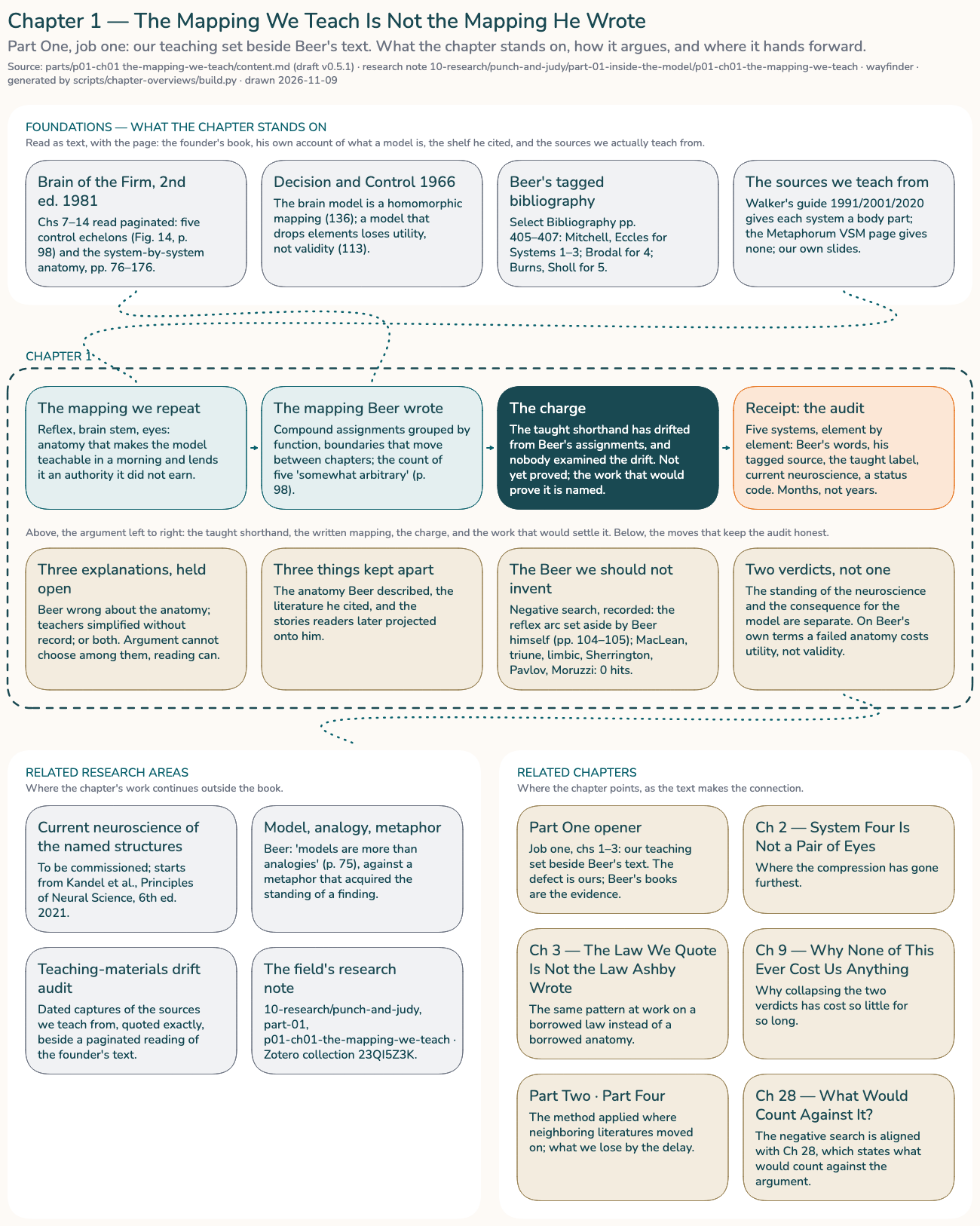
Ch 1 — The Mapping We Teach Is Not the Mapping He Wrote
Part I — Inside the model. The manuscript charges that the neuroanatomical shorthand we teach — the reflex arc, the brain stem, the eyes — has drifted from the mapping Beer set down, and that nobody examined the drift because no one had reason to look.
The question
Does the anatomical mapping we teach match the mapping Beer actually wrote?
The finding
The chapter states its charge as one it cannot yet prove. It reconstructs the written mapping from Chapters 7 to 14 of the second edition of Brain of the Firm, read as text rather than through diagrams and summaries: a five-level hierarchy drawn as control echelons, with Systems One to Five assigned to the lateral axis, the spinal cord, the medulla and pons, the diencephalon and basal ganglia, and the cerebral cortex. It notes that Beer’s assignments are compound and their boundaries shift from chapter to chapter, and that Beer himself hedged the count, writing that the choice of five is “somewhat arbitrary” (p. 98). The manuscript also records what kind of claim Beer took the mapping to be — a homomorphic mapping, a simplification whose limitations he said were understood, and one that, if it failed, would lose usefulness rather than validity — and concludes the audit must say which claim it tests.
The chapter reports a negative search result as a result in its own right. A search of the Wiley 1981 edition for MacLean, “triune,” “limbic,” Sherrington, Pavlov and Moruzzi returned none of them, and the printed index was read page by page as well. The manuscript is careful here: absence in a text is not absence from a mind, and the search can do no more than stop us attributing to Beer a specific doctrine he did not invoke.
The charged drift itself is left unresolved. It is, the chapter says, a charge it cannot yet prove, to be settled by dated captures of the sources we teach from set beside a paginated reading of Beer’s text.
What the chapter puts at risk
- A bounded, reproducible audit covering all five systems, which a small group could complete in months.
- A current-neuroscience column, to be commissioned from someone competent to read that literature, starting from one named outside text (Principles of Neural Science, 6th ed., 2021).
- Four status codes — refuted, revised, unaffected, superseded-with-addition — defined before use and defensible on each row’s own evidence.
- A stated consequence for the VSM claim and the evidence still needed, recorded narrowly per row.
Beer locators
BOTF 1981: 75, 87, 98, 99, 104–05, 124, 127, 129, 132, 135, 140–41, 144, 148, 176, 405–07 (Select Bibliography, “Specific Neurological Systems”); DC 1966 (1994 reprint): 113, 136.
Status
Draft, Punch and Judy v0.5.0 — not project canon, and not published. The drift charge is explicitly unproven. The current-neuroscience column and the status codes are work still to be commissioned. The MacLean/triune/limbic/Sherrington/Pavlov/Moruzzi result is a scoped negative search, recorded with edition, surface, date and terms, and not a claim about Beer’s mind.
Related
Homomorphism, Viable System Model, System One, System Five, Brain of the Firm, Punch and Judy — Overview, Ch 2 — System Four Is Not a Pair of Eyes, Ch 9 — Why None of This Ever Cost Us Anything