Chapter content · Overview diagram
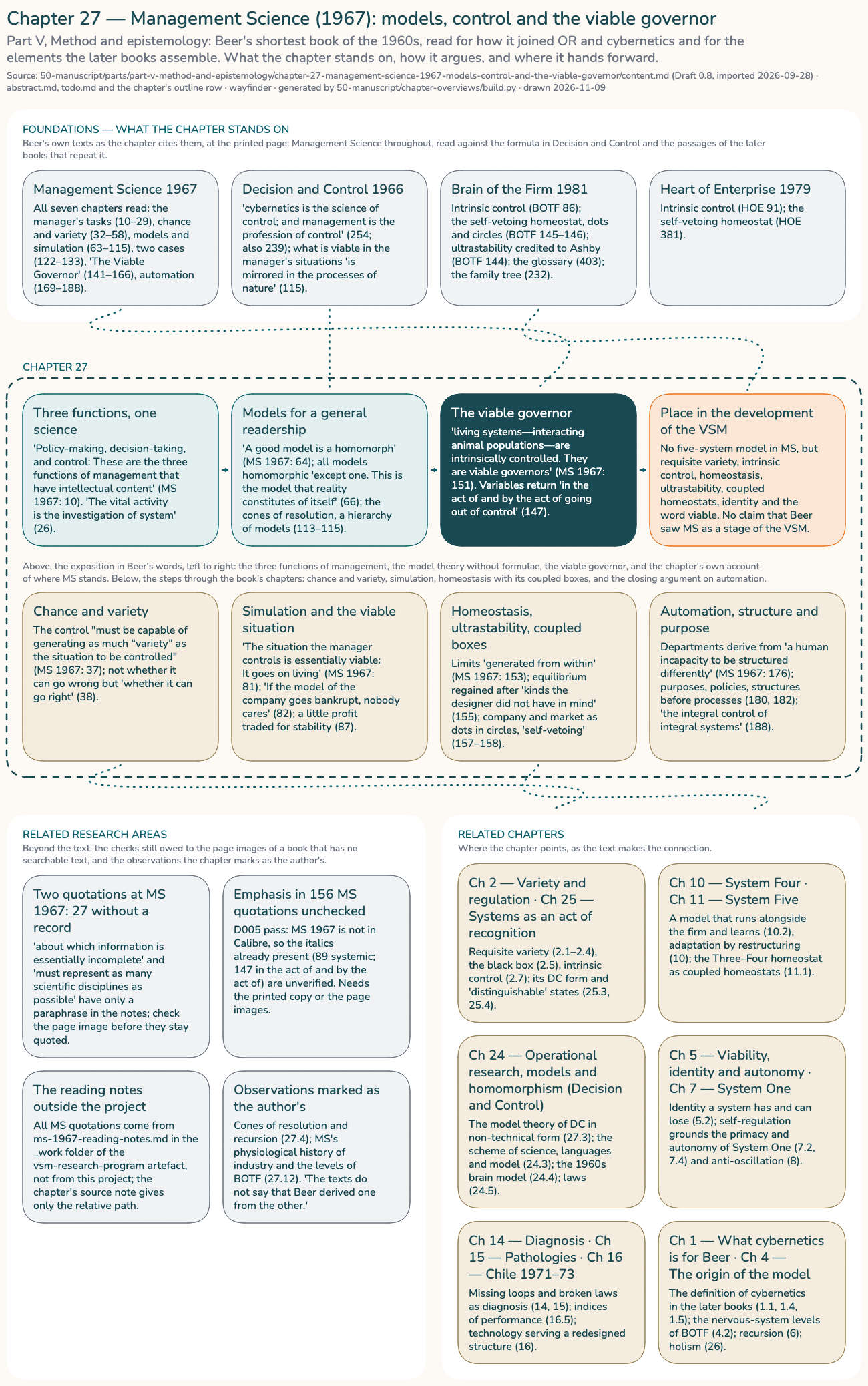
Ch 27 — Management Science (1967): models, control and the viable governor
Part V — Method and epistemology. The earliest of the books and the widest in reach: management cybernetics before the five systems had names, argued for a general readership.
The question
What did Beer already have in 1967 — before the Viable System Model existed as a five-system model?
The reading
Management Science begins with the manager’s tasks: policy-making, decision-taking and control are the three functions of management with intellectual content (MS 1967: 10). Management is an art, and to say there can be a science of management does not deny that (12); science here is systematic knowledge about the world (10). What operational research offers is the capacity to visualize the enterprise as an organic whole, to determine the structure of the underlying system that makes it what it is, and to compute in terms of that system’s dynamics — the vital activity being the investigation of system itself (26). Management science deploys a methodology developed for investigating nature to research into the manager’s own job, and is only trivially concerned with the processes being managed (19–20).
The quantities of the calculus are chance and variety. Modern science is designed to compute with probabilities rather than certainties (32), and the human being imports uncertainty into a situation just as any other natural variable does (48). Variety is “roughly defined as the possible number of distinguishable states in a situation”, and the law is that control must be capable of generating as much variety as the situation to be controlled (37); a production unit with ten processes already has nearly ten million possibilities (38), so management becomes a task of chopping down possibilities to one actuality rather than building small components up into a whole (39).
The model theory is the Decision and Control argument in plain form. The manager’s understanding is a conceptual model that maps many-to-one, and a good model is a homomorph (64); all models may be homomorphic except one, the model that reality constitutes of itself (66). An analogy alone is a literary trick unless it is made rigorous, which formal languages do (68); truth and falsity are attributes of statements about the world, not of the world, and models are more or less useful (72). Experiment on the firm being impossible, the scientist experiments on the model — simulation (81–82) — and may trade profit for stability (87). Models preserve the structural facts important to the problem on a many-to-one basis (110), and Beer arranges them in cones of resolution: at the apex a model with no resolution, at the base the uniquely isomorphic model, which is the company itself and useless for that reason — so the economy of the method is to stay as high up the cone as one can, in a hierarchy of models rather than one model (113–15).
Control is where the argument becomes a discipline. Being in control is best described as stability (143), and treating smoothness as the object of the exercise is what makes people resistant to change (144) — the point at which Beer names management cybernetics (144). The model is the Watt governor: controllability implicit in the operation of the machine, variables brought back into control in the act of going out of control, by continuous automatic comparison with a standard and continuous automatic feedback (145–47). Management by exception is an attempt to express this need and is not enough, because requisite variety is likely to be falsified (147–49). Living systems, by contrast, are intrinsically controlled — viable governors in a vast network with no managers, no controllers and no unique feedback (151, 153) — and Ashby’s names for their properties are homeostasis, limits generated from within (153), and ultrastability, the capacity to regain equilibrium after perturbations the designer did not have in mind (155), up to a threshold beyond which the system is denatured (156).
The book closes on automation. It adds the computational abilities of a brain and needs criteria of success (173); departments exist because of the limitations of hand, eye and brain, and to automate them is to enshrine those very limitations in steel, glass and semiconductors (175–77). The order of rethinking is purposes, policies, structures, problems, and only then processes (180, 182), because what is at stake is the integral control of integral systems (188).
Beer locators
MS 1967: 10–29, 32–39, 48, 63–72, 81–89, 91–115, 123–33, 141–62, 166, 169–88.
Status
Draft, Pure VSM v0.8 (2026-09-23). Beer’s texts govern where the draft and they differ.
Checked: Management Science is not available as a searchable text; a mechanical comparison found all its quotations verbatim in the reading notes taken from the page images, except two on p. 27.
Open points
- Two quotations on MS 1967: 27 — “about which information is essentially incomplete” and “must represent as many scientific disciplines as possible” — exist in the notes only as a paraphrase and need checking against the page image before they stay in quotation marks.
- 156 quotations from Management Science have not been checked for emphasis, since the book is not available in this pass.
Related
Part V — Method and epistemology, Ch 26 — Knowledge of knowing, Management Science, Variety and regulation, Homomorphism, Viability, identity and autonomy, Stafford Beer, Decision and Control.