Chapter content · Overview diagram
Ch 23 — Syntegrity and the VSM
Part IV — Team Syntegrity. The two models brought together: where syntegration sits inside the VSM, why it belongs to the Three–Four relationship, and what the book concludes about hierarchy.
The question
How does Team Syntegrity fit the Viable System Model — and does a recursive structure imply a hierarchy?
The reading
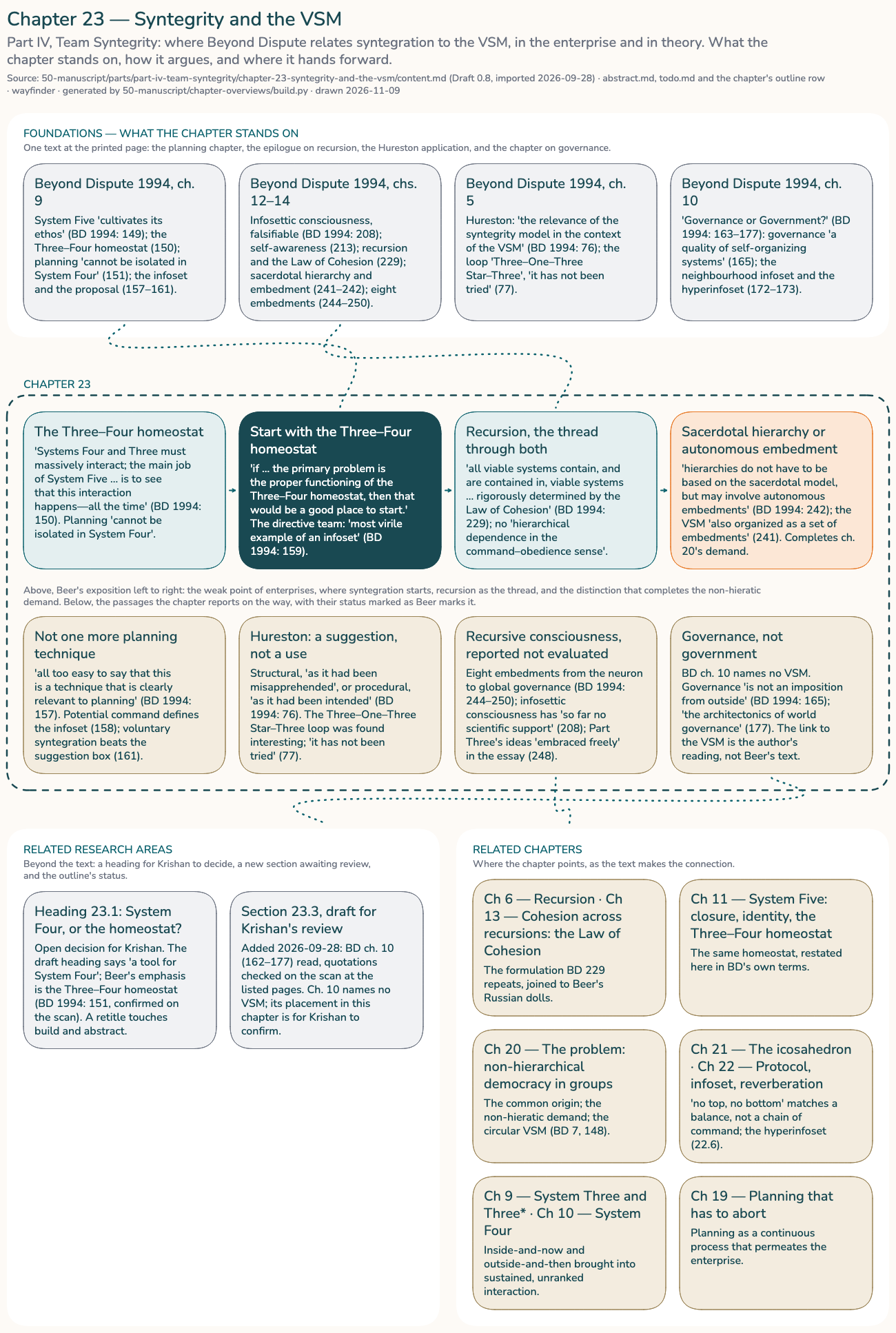
Beer places syntegration inside the model through developmental planning. The weak point of enterprises is the Three–Four relationship: System Three people see their System Four colleagues as organizational luxuries who frivol away the money System Three labours to make, while System Four sees itself as custodian of the future (BD 1994: 149). The heavy arrows of his diagram say that Systems Four and Three must massively interact, and that the main job of System Five — any included bosses notwithstanding — is to see that this interaction happens all the time (150). System Five determines purposes and in doing so cultivates the ethos (149). Developmental planning therefore cannot be isolated in System Four, although the VSM proposes that System Four be the concept of its focus (151). In one application, with the Hureston group, the relevance of the syntegrity model in the VSM context was discussed, and a characteristic repetitive loop of Three–One–Three-star–Three was suggested — and, Beer notes, not tried (76–77).
The last chapter links the model back to recursion. As embodied in the VSM, the principle asserts that all viable systems contain and are contained in viable systems, and this is not loosely expressed: it is rigorously determined by the Law of Cohesion (BD 1994: 229). Embedment does not imply hierarchy in the command-and-obedience sense, nor does it compromise the integrity of the included identity (ibid.). Beer then separates the senses of hierarchy: sacerdotal hierarchy means government by priests, where every level of authority commands all the levels below (241); hierarchies need not be based on the sacerdotal model but may involve autonomous embedments (242); and social systems, organized as a set of embedments, should not be conceived hierarchically either (241).
On that basis he develops a theory of recursive consciousness with eight embedments running from the neuron to consciousness at the level of global governance (244–50), from a starting definition that awareness is best described as self-awareness, and that consciousness is a reflection of its own activity (213). He proposes the hypothesis of an infosettic consciousness of a syntegrating group and notes that it is at least in principle falsifiable (208). The chapter also draws on his own yogic experience (247); it is reported here, not evaluated.
Beer locators
BD 1994: 76–77, 149–51, 162–77, 208, 213, 229, 241–50.
Status
Draft, Pure VSM v0.8 (2026-09-23). Beer’s texts govern where the draft and they differ.
Checked: BD 1994: 162–77 was read in the text layer for §23.3 and the quotations checked on the scans; the p. 151 wording was confirmed on the scan.
Open points
- The draft’s heading calls syntegrity “a tool for System Four”, while Beer’s emphasis falls on the Three–Four homeostat as a whole. The heading is kept and the prose follows Beer; retitling it towards the homeostat is a decision, and a heading change touches the build and the abstract.
- §23.3, on BD chapter 10 (“Governance or Government?”), was added as an item for review. Chapter 10 does not mention the VSM, and the closing paragraph that links it is marked as interpretation; whether the section belongs in this chapter is for Krishan to confirm.
Related
Part IV — Team Syntegrity, Ch 22 — Protocol, infoset, reverberation, Team Syntegrity, System Four, System Three, Law of Cohesion, Recursion, Beyond Dispute.