Chapter content · Overview diagram
Ch 17 — Freedom as a design problem
Part III — Applications and politics. Freedom treated as a design question rather than a moral one: the radio lectures written after Chile, and the formal argument in The Heart of Enterprise that turns it into a function.
The question
Can freedom be designed for — and what, in Beer’s terms, does it consist of?
The reading
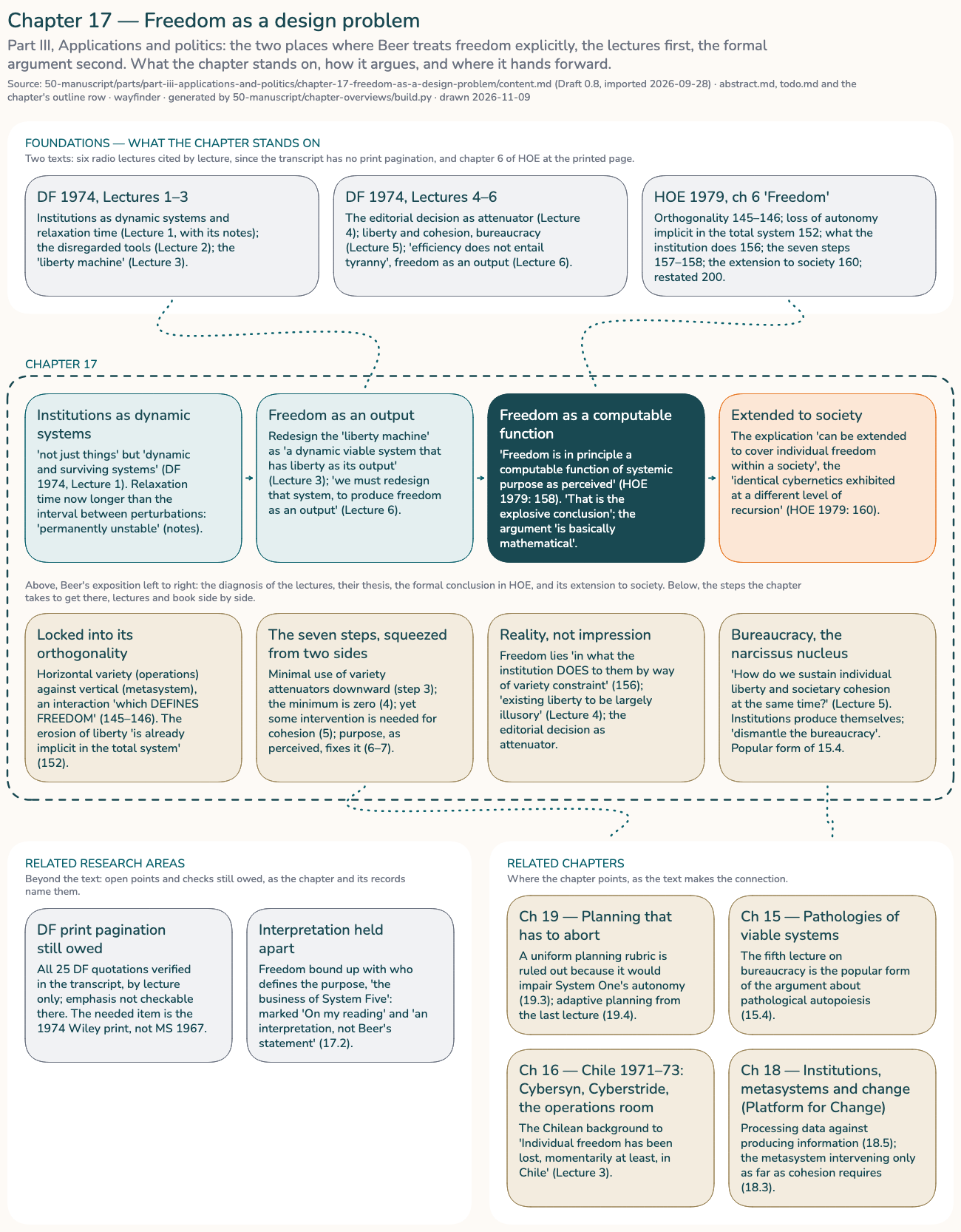
Designing Freedom is the text of six radio lectures broadcast in autumn 1973, written after Chile. Its first move is to treat institutions as dynamic and surviving systems rather than things, with a relaxation time: the time a system needs to return to stability after a perturbation. Institutions are high-variety systems subject to constant perturbation, and Beer’s hypothesis is that their relaxation time is now on average longer than the average interval between perturbations, so that the institutional system is permanently unstable (DF 1974, Lecture 1). They reduce variety to keep going — a boss constraining a subordinate’s freedom is the small case — and this is how freedom starts to be subordinated to efficiency, the alternative being total anarchy (ibid.).
The lectures then argue that institutions fail because they disobey laws of effective organization their administrators do not know (Lecture 2); that government should be redesigned as a dynamic viable system with liberty as its output rather than an entity characterised by more or less constraint (Lecture 3); that the individual’s input is attenuated by culture and media to the point where existing liberty is largely illusory (Lecture 4); that institutions produce their social benefits as by-products of the bureaucratic undertaking of producing themselves, which is why the bureaucracy has to be dismantled if institutions are to change (Lecture 5); and that efficiency does not entail tyranny if the system is got right, freedom being an output rather than a premise (Lecture 6).
The Heart of Enterprise gives the formal version. Freedom lies in the orthogonality of horizontal and vertical variety, the interaction that defines it within the viable system (HOE 1979: 145–46); the loss of autonomy is often implicit in the total system yet goes unrecognised and is blamed on autocratic management (152); and the reality of freedom in an institution lies not in the subjective impressions of those involved but in what the institution does to them by way of variety constraint (156). Beer then argues in seven steps that the metasystem should make minimal use of variety attenuators downward — the cybernetic argument for autonomy, which unlike the ethical, political or psychological arguments has no emotive content and is basically mathematical (157–58). Minimal intervention is in principle zero, but without intervention the elements would act inconsistently, so the metasystem must intervene just enough to maintain cohesiveness; and since systemic purpose is a subjective phenomenon, freedom is in principle a computable function of systemic purpose as perceived (158). The explication extends to individual freedom in a society, because it is the identical cybernetics at a different level of recursion (160).
Beer locators
DF 1974, Lectures 1–6; HOE 1979: 145–46, 152, 156–58, 160.
Status
Draft, Pure VSM v0.8 (2026-09-23). Beer’s texts govern where the draft and they differ.
Checked: all 25 quotations from Designing Freedom in the chapter occur in the transcript, in the lectures cited; the differences are transcript artefacts only.
Open points
- Designing Freedom is cited by lecture, not by page: the transcript carries no print pagination, and the 1974 Wiley print is not available. The printed book is what the citations still need.
Related
Part III — Applications and politics, Ch 16 — Chile 1971–73, Ch 18 — Institutions, metasystems and change, Viability, identity and autonomy, Pathologies of viable systems, Variety and regulation, Platform for Change, The Heart of Enterprise.