Chapter content · Overview diagram
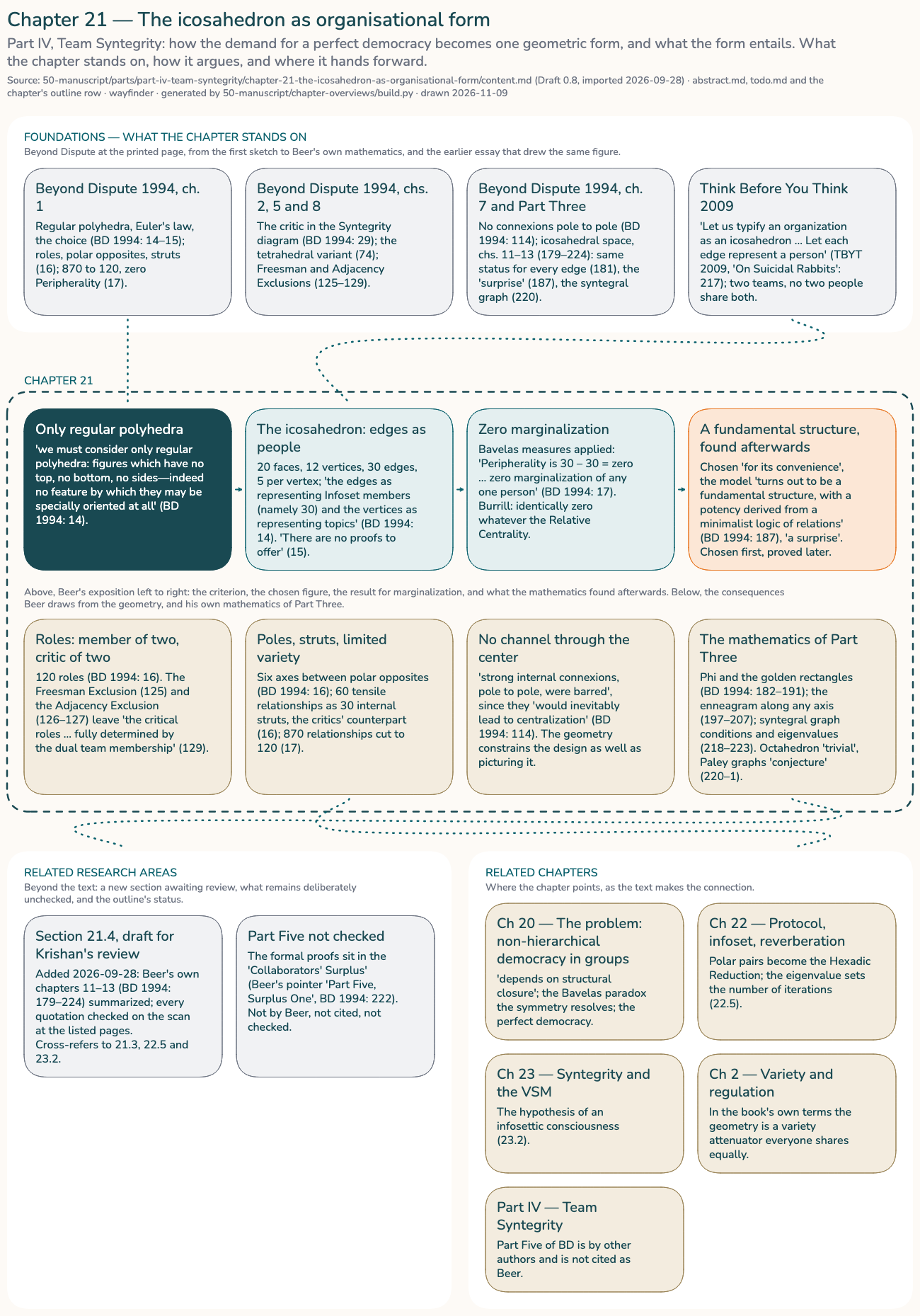
Ch 21 — The icosahedron as organisational form
Part IV — Team Syntegrity. The geometry of the protocol: why a regular polyhedron, why this one, and what its edges and vertices are made to stand for.
The question
What does a group gain by taking the shape of an icosahedron?
The reading
The requirement drives the geometry. A perfect democracy requires that no individual and initially no topic has precedence, so Beer considers only regular polyhedra — figures with no top, no bottom, no sides, indeed no feature by which they could be specially oriented at all (BD 1994: 14). Comparing the five regular convex polyhedra through Euler’s law (faces plus vertices equals edges plus two), he takes the icosahedron: twenty faces, twelve vertices, thirty edges, five edges at every vertex. Its edges are made to represent infoset members, thirty of them, and its vertices the topics, twelve (BD 1994: 14). In chapter 11 the criterion is restated as a property of the figure: each edge, a person, has exactly the same status in the geometry as every other edge (BD 1994: 181). The earlier sketch in Think Before You Think uses the same construction (TBYT 2009, “On Suicidal Rabbits”: 217).
The consequences are counted out. Each person, lying on an edge, connects two vertices and is therefore a member of two teams, and each team has five members; critics are assigned between teams, with later chapters determining the critical roles by dual team membership through two exclusion rules (BD 1994: 29, 129). Pairs of vertices furthest apart are polar opposites, which matters to the protocol (16, 29). Beyond the thirty edges there are internal relations: from each vertex five vertices that are neither neighbours nor polar opposites, making sixty internal tensile relationships represented by thirty internal struts (16).
The decisive property is the absence of a margin. Using Bavelas’s centrality measures, the icosahedron gives every player equal centrality: peripherality is thirty minus thirty, zero — which is what the presuppositions about democracy and symmetry led Beer to expect, a model with zero marginalization of any one person (BD 1994: 17).
Why this form is then argued rather than assumed. To replace hierarchic and authoritarian notions of management with a polyhedral envelope that maintains its equilibrium through the geodesic principles of tensegrity was the very basis for adopting the model (BD 1994: 114). And in Part Three Beer examines the mathematics of icosahedral space to conclude that a model first chosen for its convenience turns out to be a fundamental structure, with a potency derived from a minimalist logic of relations (BD 1994: 187).
Beer locators
BD 1994: 14, 16–17, 29, 74, 114, 129, 179–224; TBYT 2009, “On Suicidal Rabbits”: 217.
Status
Draft, Pure VSM v0.8 (2026-09-23). Beer’s texts govern where the draft and they differ.
Checked: BD 1994: 179–224 was read in the text layer for §21.4 and every quotation checked against the scans of the pages cited.
Open points
- §21.4, on the mathematics of Part Three — golden section and phi-structure, the enneagram pathway, the syntegral graph conditions, the Jalali list, Paley series and eigenvalues — was added as an item for review. Part Five, the collaborators’ chapters, was not used, and the cross-references to 21.3, 22.5 and 23.2 were written to avoid repeating material treated there.
Related
Part IV — Team Syntegrity, Ch 20 — The problem, Ch 22 — Protocol, infoset, reverberation, Team Syntegrity, Beyond Dispute, Recursion, Stafford Beer.