Chapter content · Overview diagram
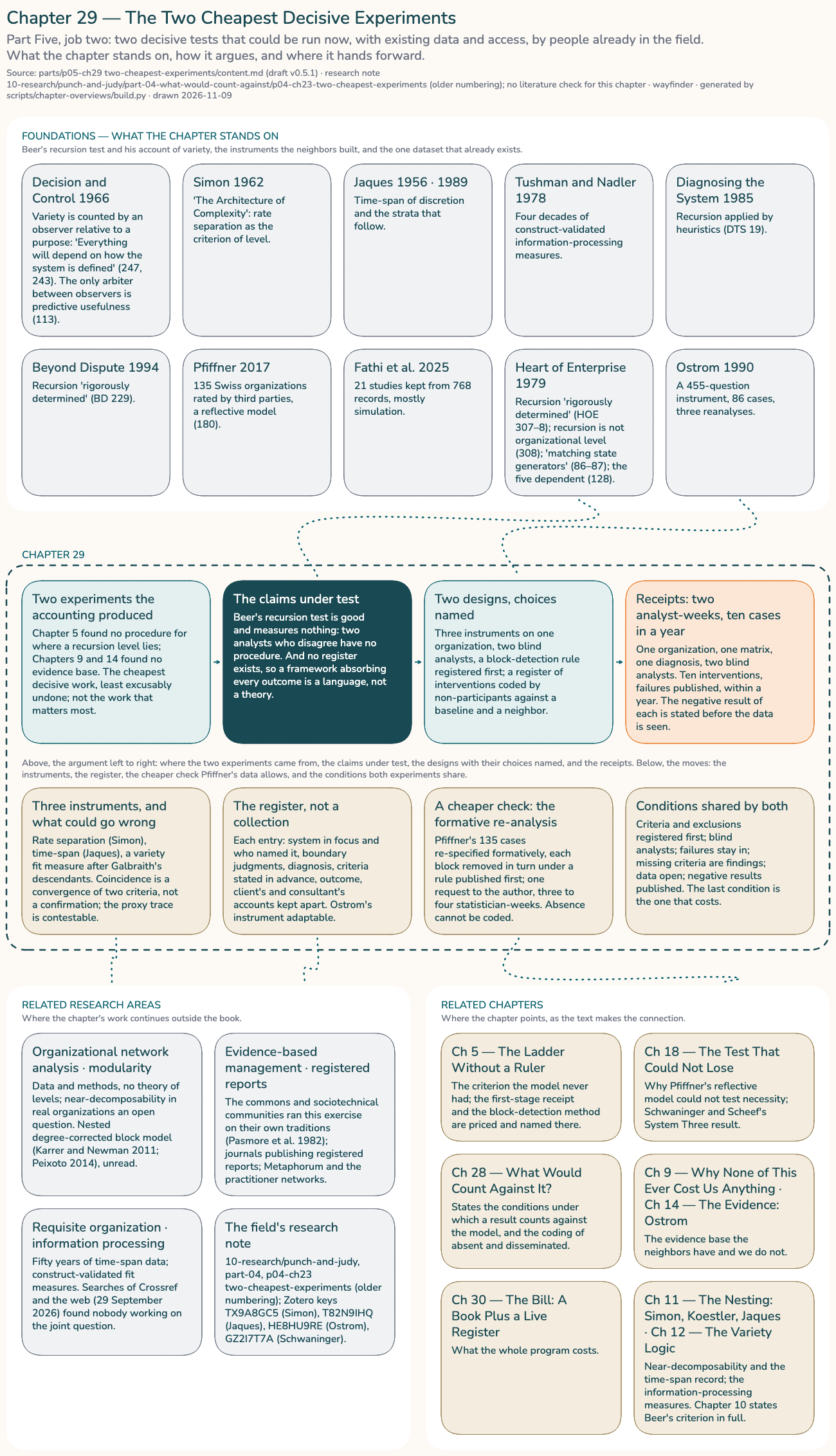
Ch 29 — The Two Cheapest Decisive Experiments
Part V — What’s at Risk in the VSM. The manuscript’s Chapter 29 sets out two decisive tests it says could be run now, with existing data and access, by people already in the field, and adds a cheaper re-analysis of data that already exist.
The question
Which decisive tests could be run now, at the lowest cost, and what would each settle?
The finding
Both experiments came out of the book’s own accounting rather than a wish list: Chapter 5 found no procedure for deciding where a recursion level lies, and Chapters 9 and 14 no evidence base. They come first because they are the cheapest decisive work available and the least excusably undone, not because they matter most. Both are proposed, not run; neither has been carried out.
Experiment one would test whether the recursion levels a diagnostician draws correspond to structure recoverable from behaviour. The claim under test is Beer’s criterion — in the authors’ paraphrase, the contained system must be viable in its own right and one of the units that do what the containing system does — plus variety’s observer-relativity, which leaves two disagreeing analysts no procedure for settling a boundary beyond rules of thumb. Three instruments are applied to the same organizations: Simon’s rate separation, read from interaction traces such as message logs, ticketing systems or deployment dependencies; Jaques’s time-span of discretion, measured at the boundaries drawn; and a variety instrument adapted from the information-processing tradition, which the chapter calls the least developed and not ready. The contestable choice of which trace is the proxy is named, with an alternative using two or three independent traces and treating their agreement as a precondition. The decision rule is registered before the data is inspected — a nested degree-corrected stochastic block model with the number of levels chosen by minimum description length — and two analysts work blind, one holding the diagnosis and the other the matrix; how time-span coincidence and non-coincidence will each be read is registered in advance.
Experiment two would test whether a VSM diagnosis predicts anything a simpler account does not, by building a retrospective register of interventions rather than a collection of success stories. Each entry would record the system in focus and who named it, the boundary judgments, the diagnosis, the intervention, criteria stated in advance, the outcome, and the client’s account kept separate from the consultant’s; a published instrument such as Ostrom’s could be adapted rather than invented. Three contestable choices are named: retrospection (weaker but startable now), the comparator (named in the registration, not chosen once cases are in hand), and breadth against depth (the opening stage chooses depth).
A cheaper check followed from reading Pfiffner’s dissertation: a formative re-analysis of his existing 135-organization dataset, removing each of the five system blocks in turn to see what each contributes to separating crisis from non-crisis cases. The original study could not test necessity, its measurement model being reflective; even the re-analysis tests necessity in Beer’s sense only where absence is coded as in Ch 28 — What Would Count Against It?.
What the chapter puts at risk
The chapter carries three named receipts, each stating the smallest fair test, a price where the book supports one, and the negative result it would establish:
- Receipt — Experiment one, first stage. One organization, one interaction matrix, one existing diagnosis, two analysts each blind to the other’s material, and a block-detection rule registered before the data is seen; priced in Chapter 5 at two analyst-weeks plus data preparation (the multi-organization extension is not yet priced). Negative result: diagnosed levels have no proxy in observed interaction structure — which counts against the equivalence of Beer’s criterion with Simon’s or Jaques’s, not against viability as Beer’s criterion.
- Receipt — Experiment two, first stage. Ten interventions, retrospectively coded by someone who did not conduct them, against criteria reconstructed from the original engagement documents, compared with a baseline and at least one neighbouring framework, all ten published including failures, and completable in about a year (the register’s continuation is not yet priced). Negative result: VSM diagnoses do not identify, in advance, failure modes or outcomes that the baseline and the neighbour also identify.
- Receipt — the formative re-analysis. Obtain the dataset, re-specify the measurement model as formative, and run the block-removal comparison under a rule published beforehand, on both the composite outcome and the original group membership. Price: one request to the author plus roughly three to four weeks of a statistician competent in structural equation modelling; no fieldwork or new instrument. If a subsystem’s removal makes no difference under the registered rule, the claim that it carries weight the others cannot supply is in trouble.
Beer locators
HOE 1979: 86–87, 116, 118, 177, 265, 307–8, 308; DTS 1985: 2, 4, 8, 19, 98, 128; DC 1966: 243, 247; BD 1994: 229.
Status
Draft, Punch and Judy v0.5.0 — not project canon, and not published. Everything here is a proposal: no experiment has been run and no result exists. The recursion criterion is the authors’ paraphrase, not a quotation; the variety instrument is called not ready; the block-model papers behind the decision rule have not been read in full and the method is to be confirmed with a network methodologist. The multi-organization extension and the register’s continuation are both expressly unpriced, and the finding that nobody works on the joint question is dated September 2026 and bounded. The re-analysis cannot code a function as absent, and its sample is Swiss, from the mid-2010s and selected at the extremes; re-specifying another’s model is an interpretive act the original author should be party to. Both designs rest on shared conditions: registration before results are inspected, blindness wherever the material permits, failures kept, missing criteria recorded as findings, data open, and negative results submitted for publication.
Related
Punch and Judy — Overview · Ch 28 — What Would Count Against It? · Ch 30 — The Bill · Recursion · Variety and regulation · Observer and recognition · Principles and axioms of organization