Chapter content · Overview diagram
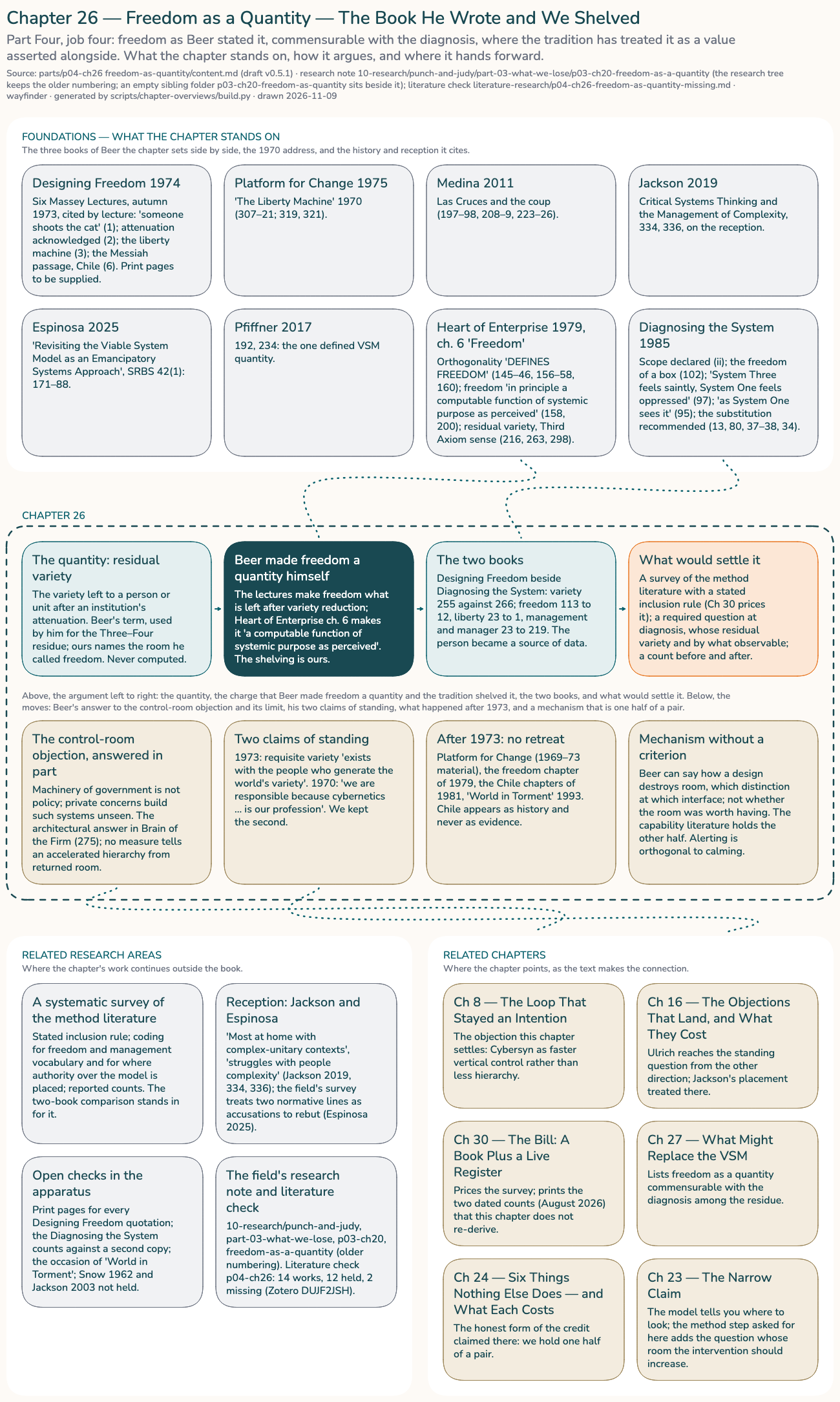
Ch 26 — Freedom as a Quantity — The Book He Wrote and We Shelved
Part IV — What we lose. The chapter argues that Beer made freedom a quantity in the model himself — declared computable but never computed — and that the tradition’s descent from his handbook, rather than from his political books, carried a substitution that put the person outside the analysis.
The question
Was freedom ever made a quantity in the model, and what became of it?
The finding
The chapter argues that the measure was Beer’s before it was anyone else’s. In the freedom chapter of The Heart of Enterprise he ends a seven-step argument with the sentence this chapter turns on, calling the reality of freedom something that lies in what the institution does to people by way of variety constraint, and declares it in principle “a computable function of systemic purpose as perceived”. He gave no procedure for computing it, and no deployment has measured it. The chapter names the quantity residual variety in the person-and-unit sense of the broadcasts, to be distinguished from Beer’s own Third Axiom use of the same phrase, which never referred to a person.
It then reads Designing Freedom (six Massey Lectures, broadcast autumn 1973) for its argument: institutions reduce variety of necessity (“someone shoots the cat”), and the citizen’s variety must be attenuated; the constructive lecture proposes a liberty machine whose output is liberty. The chapter examines Beer’s answer to the control-room objection — that it distinguishes the machinery of government from its policy — and finds it reaches a claim about purpose and accountability but not the architectural objection Chapter 8 records; he answered that architecturally in Brain of the Firm, and neither book supplies a measure that would show whether the rule held.
The depoliticization is shown by setting Designing Freedom (1974) beside Diagnosing the System for Organizations (1985): almost the same length and the same variety density, but freedom falls from 113 occurrences to 12 and liberty from 23 to 1, while management and manager together rise from 23 to 219. The chapter marks these as raw string frequencies, indicative rather than exact, with the later column not re-verified against a second copy, and rests the argument on the direction and size of the divergence, not the figures. It also reports two claims of standing Beer made three years apart, on behalf of everyone’s requisite variety and on behalf of the profession, that do not sit easily together, and admits having kept the second and let the first go quiet.
What the chapter puts at risk
The chapter carries no numbered receipt. It states three things that would settle it: a systematic survey of the method literature with a stated inclusion rule and reported counts; a required method step asking whose residual variety an intervention should increase, recorded before the intervention; and a measurement counting the distinctions available to a unit before and after a deployment. It cites Pfiffner’s viability score as precedent that a VSM quantity can be defined and published.
Beer locators
HOE 1979: 145–46, 156, 157–58, 158, 160, 200, 216, 263, 298, 567; DTS 1985: ii, 95, 97, 99, 102, 130, 134; BOTF 1981: 178–79, 271, 275–76, 288–89, 322; DF 1974 (six lectures, page references to be supplied); Platform for Change 1975: 307–21, 319, 321; Kybernetes 22, no. 6 (1993): 15–43. Other sources: Medina 2011; Jackson 2019, 334, 336; Espinosa 2025; Pfiffner 2017: 192, 234.
Status
Draft, Punch and Judy v0.5.0 — not project canon, and not published. The chapter marks the two-book comparison as a close reading standing in for a survey it has not done, the term-frequency counts as indicative, and page references for the print Designing Freedom as not established.
Related
Punch and Judy — Overview · Variety and regulation · Viability, identity and autonomy · Principles and axioms of organization · Platform for Change · The Heart of Enterprise · Diagnosing the System for Organizations · Ch 25 — The Transducer