Chapter content · Overview diagram
Ch 1 — What cybernetics is for Beer
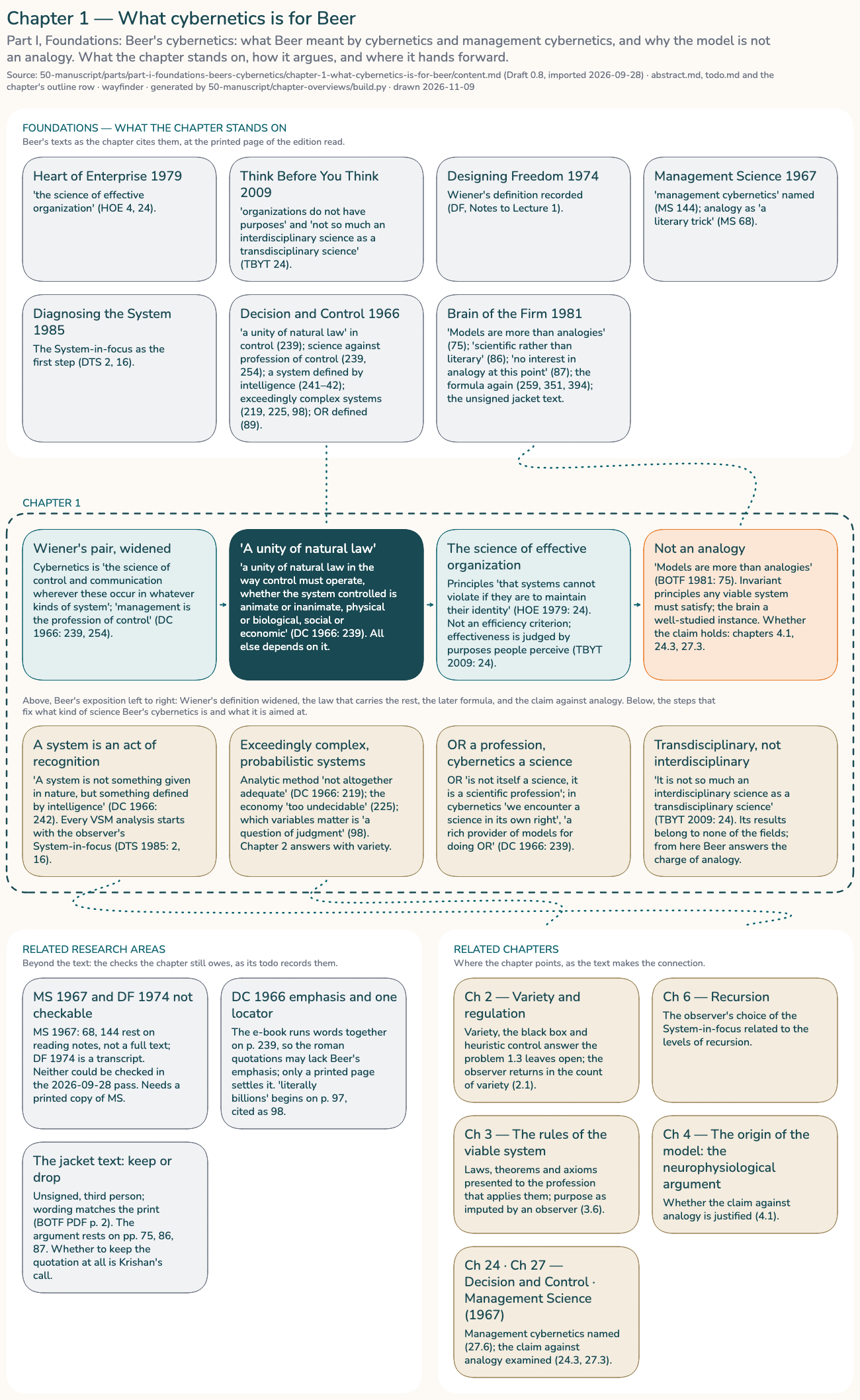
Part I — Foundations: Beer’s cybernetics. The chapter gathers Beer’s own definitions of his subject and draws the consequence the rest of the book rests on: the Viable System Model is an application of a science of principles, not a management technique and not an analogy.
The question
What is cybernetics as Beer uses the word — and why should anyone organizing take it as the ground of the work rather than as a vocabulary borrowed from machines?
The reading
Beer works towards a definition rather than starting from one. He records Wiener’s formula — control and communication in the animal and the machine (DF 1974, Notes to Lecture 1) — and in Decision and Control widens it to control and communication wherever they occur, in whatever kind of system, resting on the claim that one body of natural law governs how control must operate whether the system is animate, inanimate, social or economic (DC 1966: 239). The hinge for management is short: cybernetics is the science of control; and management is the profession of control (DC 1966: 254). A year later he names the resulting subject management cybernetics (MS 1967: 144).
The short formula he settles on is “the science of effective organization” (HOE 1979: 4). What that science contains is a set of principles a system cannot violate if it is to maintain its identity (HOE 1979: 24). Two consequences follow, and the chapter holds to both: cybernetics is a science of invariant principles, not a bag of techniques; and “effective organization” is not an efficiency criterion — the test is whether identity and viability are kept, not whether the operation runs efficiently.
Systems, on this account, are not found in nature. A system is defined by intelligence, and the coherence of a collection of entities is a matter of mental recognition (DC 1966: 241–42), so every VSM analysis opens with the observer’s decision about which system is in focus — a point the book takes up again in chapter 6.
The last three sections explain why the subject has this shape. Analytic method is not adequate to large, exceedingly complex systems (DC 1966: 219): the economy, Beer’s example, is “exceedingly complex” (DC 1966: 225) and has literally billions of variables whose importance is a matter of judgment and convention rather than measurement (DC 1966: 98). Operational research is a profession practising science in the management sphere; cybernetics is a science in its own right and the provider of its models (DC 1966: 239). It is transdisciplinary rather than interdisciplinary (TBYT 2009, “Laws of Anarchy”: 24), and the brain–firm relation is a pursuit of principles, not an analogy — models are more than analogies, and comparison is not the point (BOTF 1981: 75, 86–87).
Beer locators
BOTF 1981: 75, 86–87; DC 1966: 89, 98, 219, 225, 239, 241–42, 254; DF 1974, Notes to Lecture 1; HOE 1979: 4, 24; MS 1967: 144; TBYT 2009, “Laws of Anarchy”: 24.
Status
Draft, Pure VSM v0.8 (2026-09-23). Beer’s texts govern where the draft and they differ.
Checked: the Brain of the Firm jacket text quoted in §1.6 matches the scan (BOTF 1981, p. 2 flap), but the flap is unsigned and speaks of Beer in the third person, so authorship cannot be settled from the book; the body quotations carry the same point (BOTF 1981: 75, 86–87). Unchecked: the MS 1967 pages rest on reading notes, not on a full text, and Decision and Control is an e-book whose p. 239 has lost the print’s emphasis.
Open points
- The jacket quotation in §1.6: wording verified, authorship unresolved — whether to keep it at all is an open decision.
- MS 1967: 68, 144 and the DF 1974 transcript rest on reading notes and a transcript, not a printed text; the roman type of the DC quotations may lack Beer’s emphasis.
Related
Part I — Foundations, Ch 2 — Variety and regulation, Viable System Model, Observer and recognition, Principles and axioms of organization, Viability, identity and autonomy, Stafford Beer, Decision and Control, Brain of the Firm.