Chapter content · Overview diagram
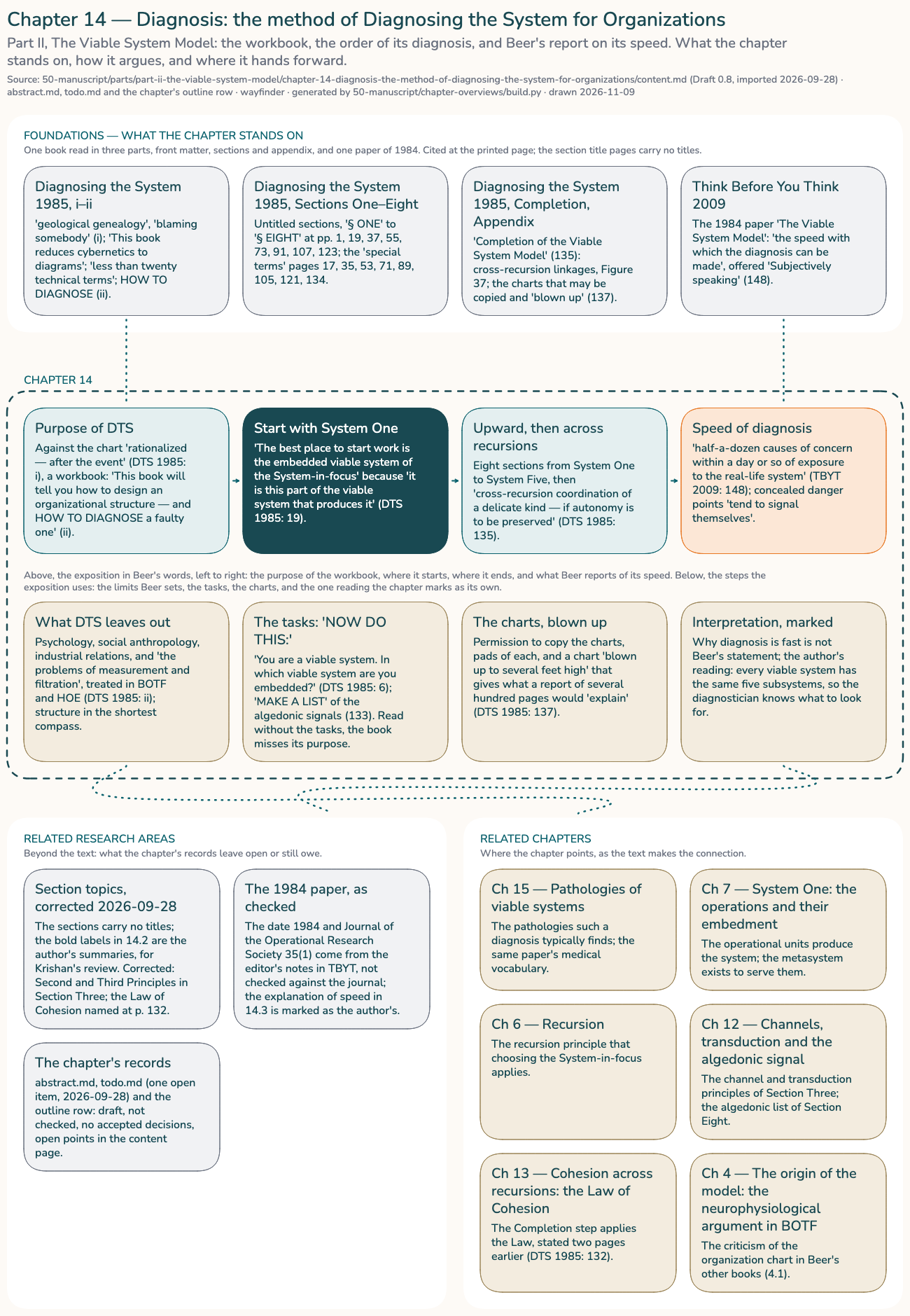
Ch 14 — Diagnosis: the method of Diagnosing the System for Organizations
Part II — The Viable System Model. The model turned into a procedure: the book Beer wrote to be used on an organization, and the order in which it tells you to walk through it.
The question
How does one actually diagnose an organization with this model — and in what order does the diagnosis proceed?
The reading
Beer sets the workbook against the organization chart, which he calls a geological genealogy, useful mainly as a procedural method for blaming somebody for whatever has gone wrong (DTS 1985: i); in its place, “this book will tell you how to design an organizational structure — and how to diagnose a faulty one” (DTS 1985: ii). It gets by with fewer than twenty technical terms and deliberately leaves out psychology, measurement and filtration, which belong to the other books (ibid.).
The order is itself part of the method. The reader chooses the System-in-focus and its recursions (Section One); starts with System One, because the embedded viable system is the part that produces the system (Section Two, from p. 19); walks the command axis, the resource bargain, channels and transducers with the Second and Third Principles (Section Three); takes the Fourth Principle, System One as a whole and oscillation (Section Four); System Two, the six vertical channels including audit, and System Three (Section Five); System Three again with managerial style and the convergence of purpose (Section Six); System Four, the Three–Four homeostat and the Second Axiom (Section Seven); and closes with System Five, closure, the Law of Cohesion and the algedonic signal (Section Eight). A final “Completion of the Viable System Model” adds the cross-recursion linkages, where System Two and Three-star require coordination of a delicate kind if autonomy is to be preserved (DTS 1985: 135). Throughout, the reader is given tasks to perform, and the appendix holds diagnostic charts meant to be copied and enlarged: on a VSM chart blown up to several feet high, Beer says, it is often possible to give a succinct account of an organization, and its diagnosis, that would take a report several hundred pages to explain (DTS 1985: 137).
The claim for the method is speed rather than ease. In the 1984 paper Beer says his confidence derives not so much from the fact that the pathology can be investigated with ease as from the speed with which the diagnosis can be made: the knowledgeable user may expect to home in on half a dozen causes of concern within a day or so of exposure to the real-life system (TBYT 2009, “The Viable System Model”: 148).
Beer locators
DTS 1985: i–ii, 1–137 (the eight sections and the Completion; the section pages carry no titles); TBYT 2009, “The Viable System Model”: 148.
Status
Draft, Pure VSM v0.8 (2026-09-23). Beer’s texts govern where the draft and they differ.
Checked: the section title pages carry no titles, only a hand-lettered “§ ONE” to “§ EIGHT” (scans of pp. 1, 19, 37, 55, 73, 91, 107, 123), and the topics were then checked against the text layer and the special-terms pages. The bold item labels in the chapter’s §14.2 are the draft’s summaries, not Beer’s titles.
Open points
- The bold labels are summaries and may want rephrasing.
- The topics were corrected against the scans during the 2026-09 pass — the Second and Third Principles and transduction belong to Section Three (42–53), Section Four holds the Fourth Principle and the whole of System One, and the Completion page is headed “Completion of the Viable System Model” (135).
Related
Part II — The Viable System Model, Ch 13 — Cohesion across recursions, Ch 15 — Pathologies of viable systems, Diagnosing the System for Organizations, Viable System Model, Principles and axioms of organization, Law of Cohesion, Stafford Beer.