Chapter content · Overview diagram
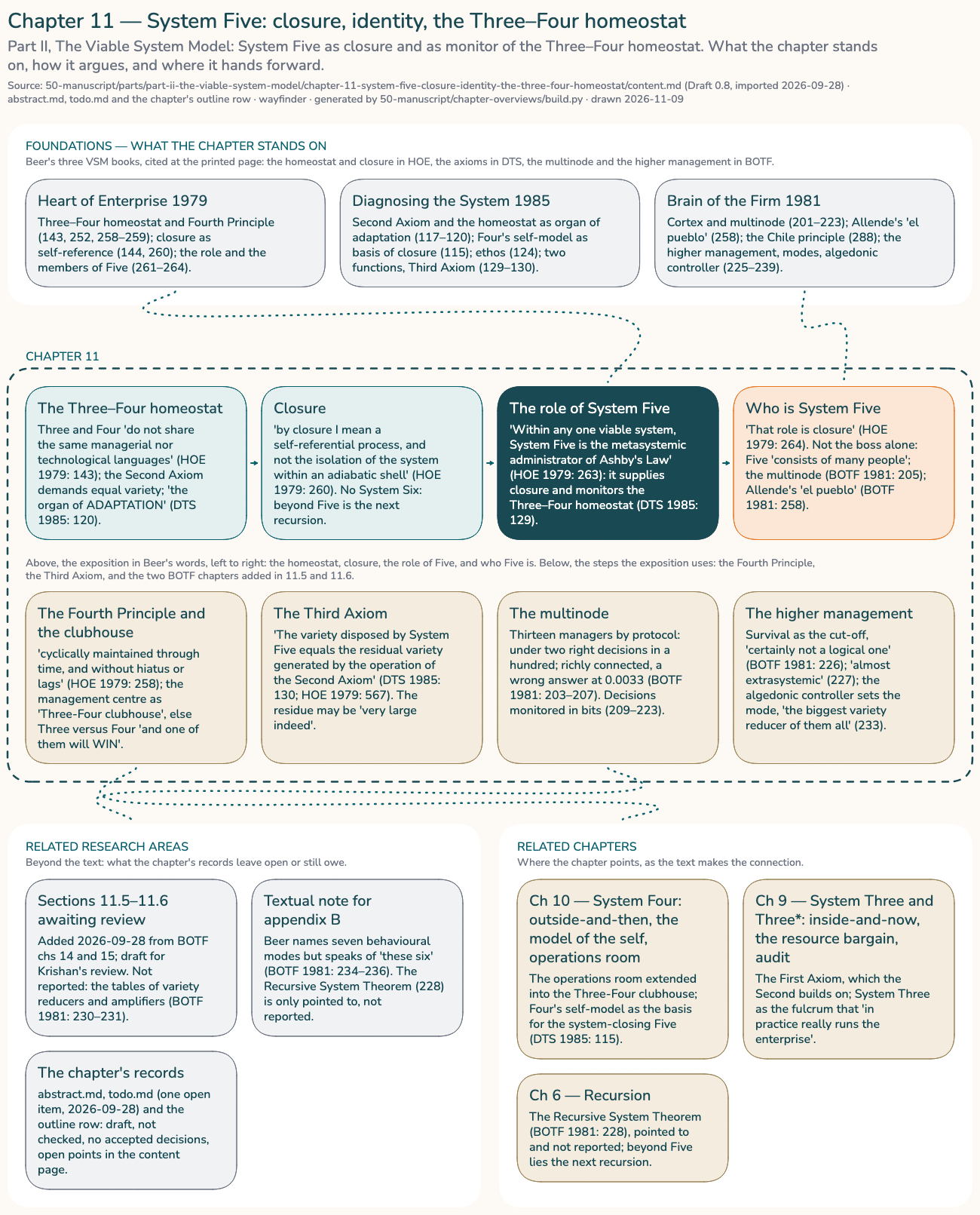
Ch 11 — System Five: closure, identity, the Three–Four homeostat
Part II — The Viable System Model. The top of the model, and the least like a boss: the system that closes the whole and watches the balance between the present and the future.
The question
What does System Five do — and why does Beer insist that it is neither the top of an organization chart nor a single person?
The reading
The chapter begins with the homeostat System Three and System Four form, which is where adaptation happens. They must absorb each other’s variety, and that is hard: they do not share the same managerial or technological languages, and their criteria of success consider different spans of time (HOE 1979: 143). The Second Axiom requires equal variety between them (HOE 1979: 298; DTS 1985: 118), and the Three–Four homeostat is “the organ of adaptation for the enterprise” (DTS 1985: 120). In a management centre the two would exhibit themselves to each other continuously and absorb each other’s variety (HOE 1979: 258) — which is the setting for the Fourth Principle’s requirement that the first three operate without hiatus or lag.
System Five arises from closure, the process by which the viable system turns in on itself to become an identity (HOE 1979: 144). Beer is careful about the word: closure is self-reference, not the isolation of the system in an adiabatic shell (HOE 1979: 260); in DTS, logical closure means above all self-reference, the assertion of identity (DTS 1985: 130). There is no System Six: what lies beyond System Five is the next level of recursion, of which this fivefold system is an operational element (HOE 1979: 259).
Its role is then stated twice, once as administration and once as monitoring. Any high variety generated between Systems Three and Four and not absorbed there is closed by System Five (HOE 1979: 261); in a working homeostat, all that remains for System Five is to monitor the regulatory machinery and see that it does not embark on an uncontrolled oscillation (HOE 1979: 262). Beer’s summary is that its key role is as monitor of the variety sponge between Three and Four — the administrator of Ashby’s law in the metasystem (HOE 1979: 144, 263); DTS puts the two functions in one sentence, supplying logical closure and monitoring the homeostat (DTS 1985: 129). The Third Axiom follows: the variety disposed by System Five equals the residual variety generated by the Second (DTS 1985: 130). DTS adds how it sets rules — less by stating them firmly than by creating a corporate ethos, an atmosphere (DTS 1985: 124).
Who this is, is the chapter’s last surprise. System Five is not simply the boss: with great respect to System Five, for there sits the boss, System Three in practice really runs the enterprise (HOE 1979: 263). Under democratic conventions System Five consists of many people, and except for genuine autocracies it includes many people, contrary to popular belief (HOE 1979: 263–64). BOTF models it as the multinode, an elaborately interactive assemblage of elements rather than a well-mannered collection of nodes (BOTF 1981: 205). Chile gave Beer the political version: for Allende, System Five was the people, and his first principle for the project says System Five in a people’s government cannot be an elite ruling class (BOTF 1981: 258, 288).
Beer locators
BOTF 1981: 205, 234–36, 258, 288; DTS 1985: 118–20, 124, 129–30; HOE 1979: 143–44, 258–64, 298, 567.
Status
Draft, Pure VSM v0.8 (2026-09-23). Beer’s texts govern where the draft and they differ.
Checked: BOTF chapters 14 and 15 were read in full for §11.5 and §11.6 and the quotations checked against the scans.
Open points
- Sections 11.5 (the multinode and the monitoring of decisions) and 11.6 (the higher management) were added as items for review and stay open until read. Not reported there: the Recursive System Theorem, only pointed to, and the tables of variety reducers and amplifiers (BOTF 1981: 230–31).
- Appendix B note: Beer names seven behavioural modes but speaks of “these six” (BOTF 1981: 234–36).
Related
Part II — The Viable System Model, Ch 10 — System Four, Ch 12 — Channels and the algedonic signal, System Five, Viability, identity and autonomy, Principles and axioms of organization, The Heart of Enterprise, Brain of the Firm, Stafford Beer.