Chapter content · Overview diagram
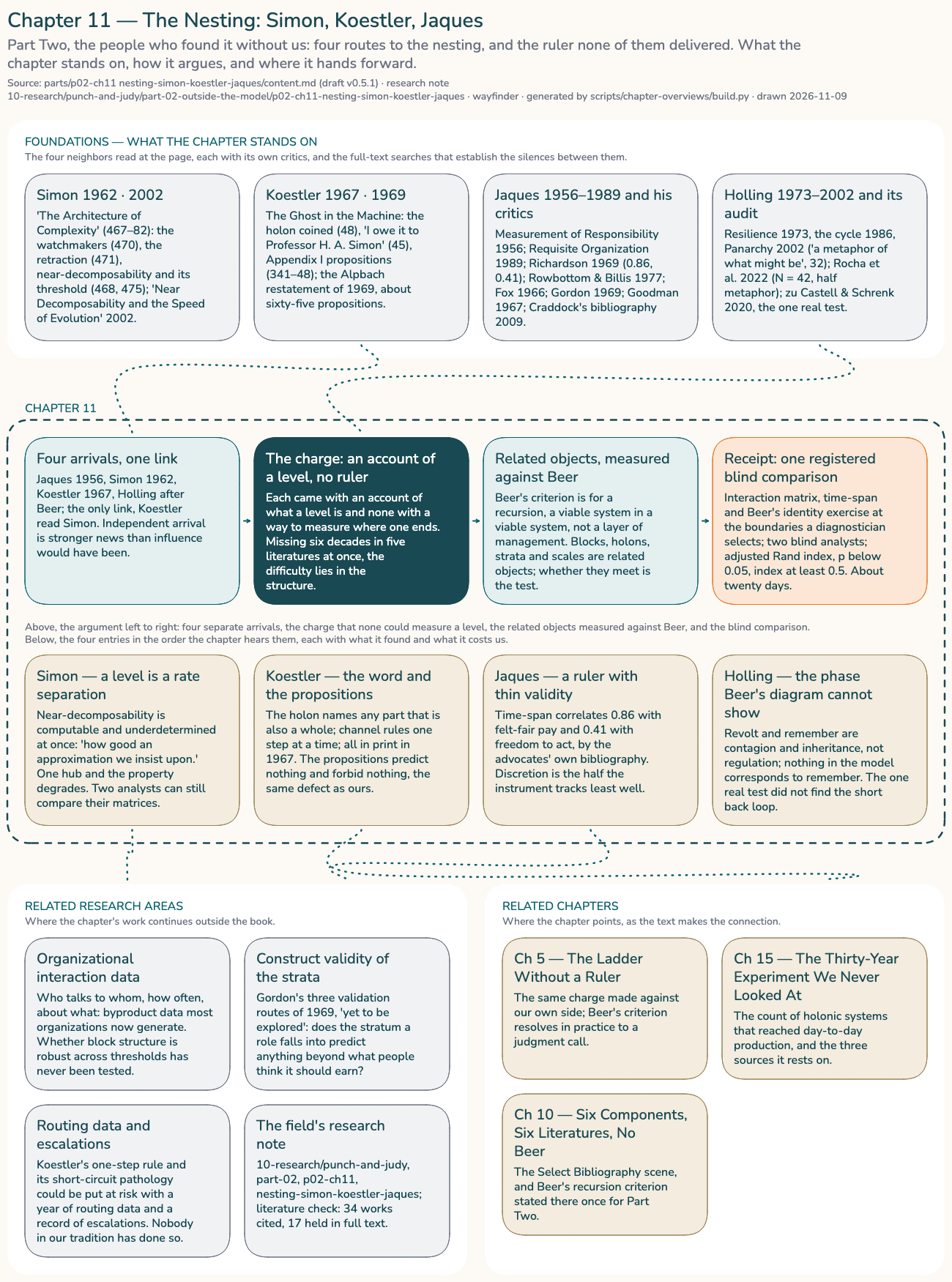
Ch 11 — The Nesting: Simon, Koestler, Jaques
Part II — Outside the model. The chapter follows independent arrivals at the nesting of systems within systems — Simon, Koestler, Jaques and Holling’s panarchy — and argues that each came with an account of what a level is but none with a way of measuring where one ends.
The question
Who made cross-scale nesting operational, and how far did they get?
The finding
The chapter assembles the citation record first. The Select Bibliography of Brain of the Firm and the earlier Decision and Control name none of Simon, Koestler or Jaques; Pickering’s history has no Koestler and one incidental Simon, which the chapter flags as an index result rather than a concordance; and Simon’s 1962 paper cites Wiener and Ashby but neither Beer nor Koestler. Only one link runs between any two of these bodies of work, and it is a declared debt: Koestler read Simon, and says so where he coins the holon.
Each of the four entries is then given an equal hearing and compared against Beer’s recursion criterion (a viable system inside a viable system, stated in Chapter 10). Simon’s near-decomposability is a criterion computable in principle over observable interaction rates, but its threshold — the epsilon that separates a level — is set by the analyst, and Simon says so. Koestler’s proposition set gives a name for the recursing thing and channel rules stated sharply enough to be broken, but it predicts and forbids nothing. Jaques’s time-span of discretion produces a number attached to a role, on mixed evidence: the strongest pile supports felt-fair pay, the middle pile is his own circle citing itself, and the measure predicts discretion poorly. Holling’s panarchy arrives after Beer, so it is convergence rather than prior art; its revolt and remember couplings have no counterpart in Beer’s phase-invariant recursion, and a 2022 insider review finds the framework used largely as metaphor and rarely tested on its cross-scale couplings.
The single result: four people saw related structures independently and none could measure them, and the one real test of panarchy’s phases came back against the framework. Where the chapter found no study, it says so — for instance, no independent psychometric validation of Jaques’s cognitive-maturation curves — and it corrects a sentence earlier drafts had misattributed to Rocha and colleagues.
What the chapter puts at risk
- Build an interaction matrix from observed rates of interaction.
- Record time-span of discretion for the roles heading each candidate recursion’s management, at boundaries an experienced VSM diagnostician independently selects.
- Add Beer’s identity exercise as a third, cheap boundary reading beside time-span.
- Give the matrix and the VSM account to two blind analysts and ask each to reconstruct the level structure, with protocol and agreement criterion registered before the run (agreement as the adjusted Rand index; chance by permutation test; convergence requires p below 0.05 and an index of at least 0.5).
- Treat a negative result as publishable in advance: if the boundaries do not converge beyond chance, the claim that recursion identifies an observable level structure is weakened.
Beer locators
BOTF 1981: xii, 234-35, 284, 384, 405-10; DC 1966: 104-5, 242, 243, 384, 388, 396; DTS 1985: 2, 8, 19, 38-39, 135; HOE 1979: 116, 118, 158, 308, 336, 407, 417-33, 419, 432.
Status
Draft, Punch and Judy v0.5.0 — not project canon, and not published. The chapter marks several findings as limited or negative: the Pickering and third-edition Simon results are index results rather than concordances; the “0.86” and “0.41” figures come from the movement’s own annotated bibliography; the negative search for an independent validation of the maturation curves is the authors’ own negative; and the count of holonic production systems, made in Chapter 15, rests on three sources that would have reported a deployment had one existed. Its Beer quotations were checked against the PDFs on 29 September 2026.
Related
Punch and Judy — Overview, Recursion, System One, System Three, System Five, Observer and recognition, Ch 10 — Six Components, Ch 12 — The Variety Logic: Galbraith