Chapter content · Overview diagram
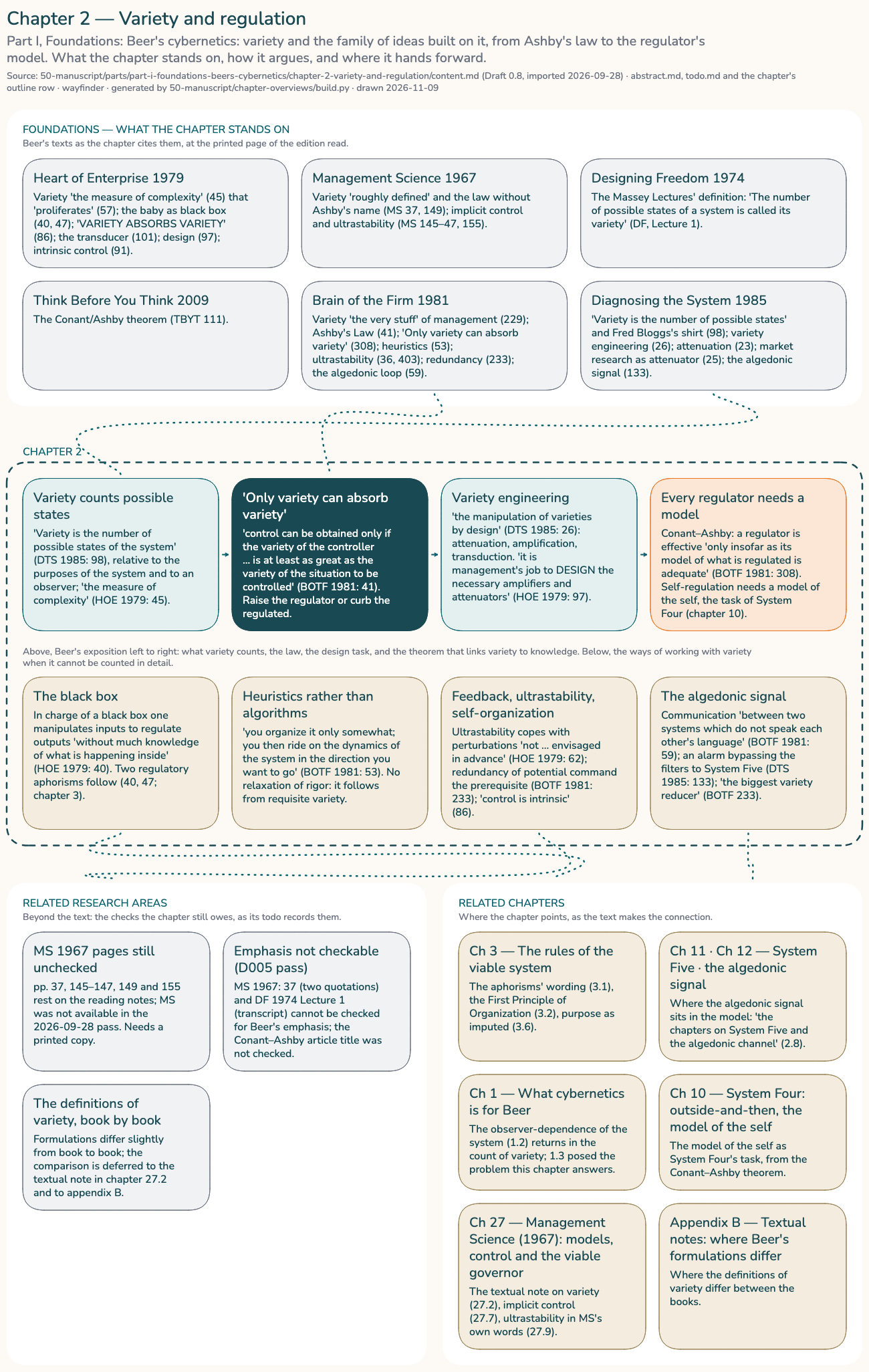
Ch 2 — Variety and regulation
Part I — Foundations: Beer’s cybernetics. Nine sections build the vocabulary the model will rest on: what variety is, the law that constrains it, the engineering that balances it, and the theorem that a regulator needs a model.
The question
How is a system to be controlled when it is too complex to be specified — and what does Beer’s answer, variety, actually measure?
The reading
Variety is the possible number of distinguishable states of a situation, and Beer’s definitions stay close to Ashby’s across three books (MS 1967: 37; DF 1974, Lecture 1; DTS 1985: 98), with The Heart of Enterprise calling it the measure of complexity (HOE 1979: 45). Two qualifications govern its use: it is counted relative to an observer and a purpose, so the question of which states count at all is asked immediately after the definition (DTS 1985: 98).
Variety is what management works on, and it grows. Beer gives it the place matter had for earlier generations — the stuff and substance of management in a newly complicated milieu (BOTF 1981: 229) — and treats its proliferation as a natural law of interactive systems: the manager’s task is to handle the proliferating variety of the situation they work in (HOE 1979: 57).
Ashby’s law is the constraint: control is obtainable only if the controller’s variety is at least as great as that of the situation controlled (BOTF 1981: 41). Beer builds it in two steps — variety absorbs variety (HOE 1979: 86) — and states the sharper form in the Chile chapters: only variety can absorb variety, which can be met either by expanding regulatory variety or by curbing the learning that generates variety in the first place (BOTF 1981: 308). Because environment always outruns operation and operation outruns management, the balance has to be designed: attenuation cuts arriving variety to what the receiver can handle (DTS 1985: 23), amplification raises management’s own (DTS 1985: 25), and transduction translates across a boundary, a transducer’s variety matching the channel’s (HOE 1979: 101). Designing these amplifiers and attenuators is management’s job (HOE 1979: 97), which yields the First Principle of Organization in chapter 3.
The rest of the chapter removes the hope of doing this in detail. Complex systems are black boxes that need not be entered to be understood or to have their variety estimated (HOE 1979: 40, 47); control is heuristic rather than algorithmic — organize somewhat, then ride the system’s dynamics (BOTF 1981: 53); and control should be intrinsic, so that the system is brought back on course in the very process of going off it (BOTF 1981: 36, 86; HOE 1979: 62, 91), with the redundancy of potential command as the precondition of self-organization (BOTF 1981: 233). The algedonic signal is the exception to the filters: an alarm that reaches System Five past the normal channels (BOTF 1981: 59, 233; DTS 1985: 133). The chapter closes with the Conant–Ashby theorem — every good regulator must be a model of what it regulates (TBYT 2009, “The Will of the People”: 111) — which is why System Four must hold a model of the whole (chapter 10).
Beer locators
BOTF 1981: 36, 41, 53, 59, 86, 229, 233, 308; DF 1974, Lecture 1; DTS 1985: 23, 25, 98, 133; HOE 1979: 40, 45, 47, 57, 62, 86, 91, 97, 101; MS 1967: 37; TBYT 2009, “The Will of the People”: 111.
Status
Draft, Pure VSM v0.8 (2026-09-23). Beer’s texts govern where the draft and they differ.
Checked in the 2026-09 pass: DF 1974 Lecture 1 (transcript), DTS 1985: 133 and TBYT 2009: 111 against the text layer and the scans. Unchecked: the MS 1967 pages, which rest on reading notes.
Open points
- MS 1967: 37, 145–47, 149, 155 are not checked and need a printed copy.
- DF 1974 is a transcript; the Conant–Ashby article title in the references is not a Beer quotation and has not been checked.
- Emphasis in the MS 1967 quotations cannot be verified from the sources available.
Related
Part I — Foundations, Ch 1 — What cybernetics is for Beer, Ch 3 — The rules of the viable system, Variety and regulation, Algedonic signal, System Five, System Four, Viable System Model.