Chapter content · Overview diagram
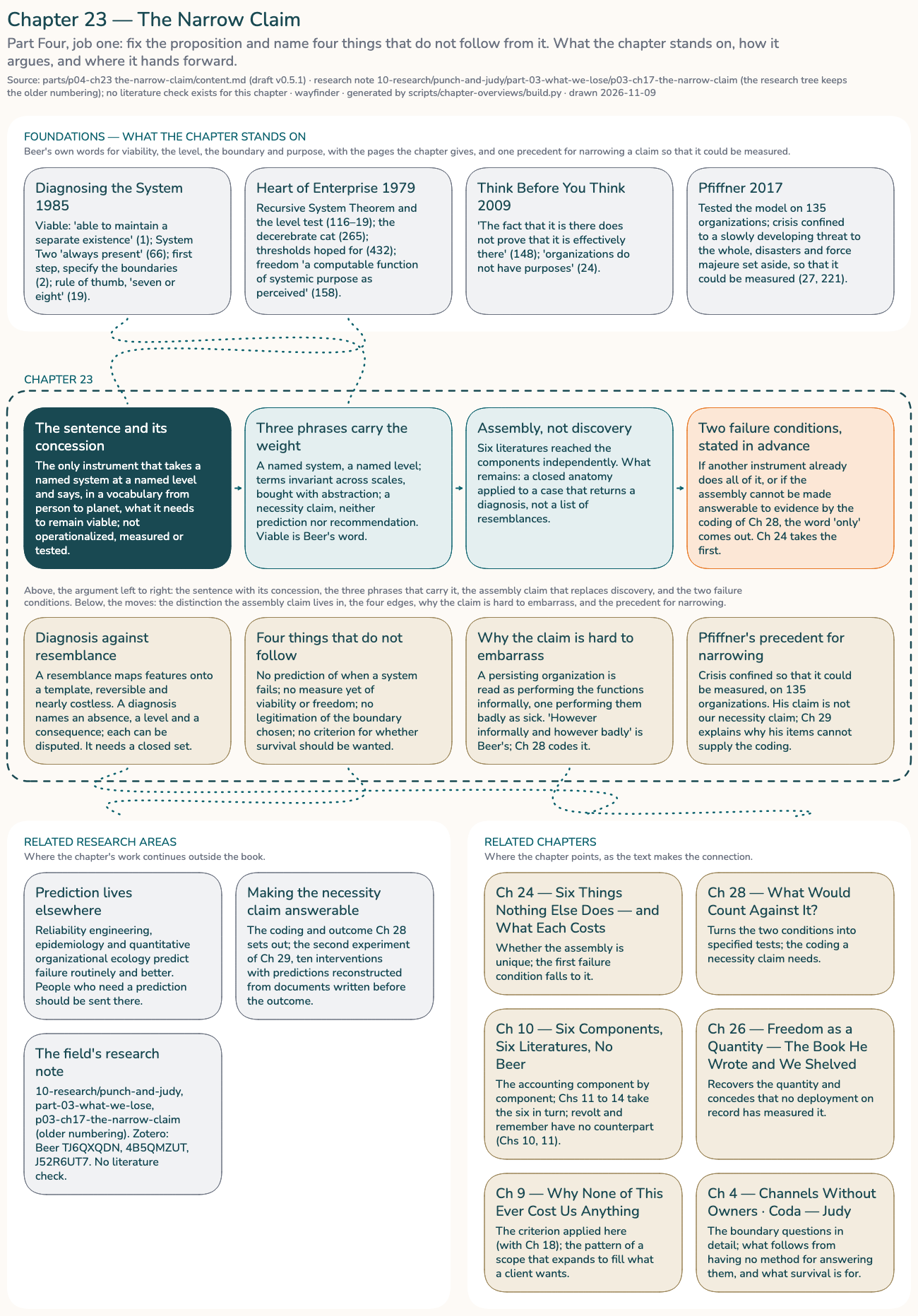
Ch 23 — The Narrow Claim
Part IV — What we lose. The chapter states the manuscript’s narrow claim: the VSM is the only available instrument that takes a named system at a named level and says, in a vocabulary that survives the journey between a person and a planet, what that system needs in order to remain viable — while conceding that we have not operationalized that necessity, measured it, or designed the comparative test that could falsify it.
The question
What exactly is the narrow claim, and what does it not licence the tradition to say?
The finding
The chapter argues that three phrases carry the claim, and that the claim and its concession cannot be separated: a reader who quotes the first half without the second has not quoted them. A named system at a named level means a particular case at a particular recursion, not firms in general or all levels at once; the chapter reports that most diagnostic disagreements it has witnessed are level confusions, and that without both names no generated sentence can be checked. A vocabulary that survives the journey between a person and a planet asserts only that the same small set of terms can travel across scales without a new vocabulary — a property bought with abstraction, which is the same feature that makes the terms hard to operationalize. What the system needs in order to remain viable is a necessity claim that carries no prediction and no recommendation. Viability here is Beer’s, meaning, in his definition, “able to maintain a separate existence”, and he refused to let bare existence stand in for it: an institution whose System Four is empty he called a decerebrate cat that lives on under artificial sustenance.
The chapter argues the claim had to be made smaller because six neighbouring literatures reached most of the model’s components independently, in several cases earlier and with a better evidential record. The discovery claim is therefore gone; what remains is an assembly claim, and the chapter distinguishes a diagnosis (a named absence, at a level, with a consequence) from a resemblance (a reversible, nearly costless degree of fit). It is explicit that diagnostic form is not diagnostic accuracy, and it treats Pfiffner’s narrowing of crisis as a precedent, not as supplying the manuscript’s necessity claim.
What the chapter puts at risk
The chapter carries no numbered receipt. It states two failure conditions: the claim fails if another instrument already does all of this, or if the assembly cannot be made answerable to evidence by a coding and outcome of the kind Chapter 28 sets out.
Beer locators
DTS 1985: 1; HOE 1979: 113; TBYT 2009: 148; HOE 1979: 265; DTS 1985: 66; HOE 1979: 143; HOE 1979: 432; HOE 1979: 116–19 (Recursive System Theorem at 118); HOE 1979: 158, 565; TBYT 2009: 24; HOE 1979: 412; DTS 1985: 2, 19. Other source: Pfiffner 2017: 27, 221.
Status
Draft, Punch and Judy v0.5.0 — not project canon, and not published. The chapter itself marks its necessity claim as not yet stated in a form a counterexample could embarrass — a definition wearing the clothes of a finding — and carries the Part One concession into Part Four.
Related
Punch and Judy — Overview · Viable System Model · Recursion · Variety and regulation · Diagnosing the System for Organizations · The Heart of Enterprise · Think Before You Think · Ch 24 — Six Things Nothing Else Does