Chapter content · Overview diagram
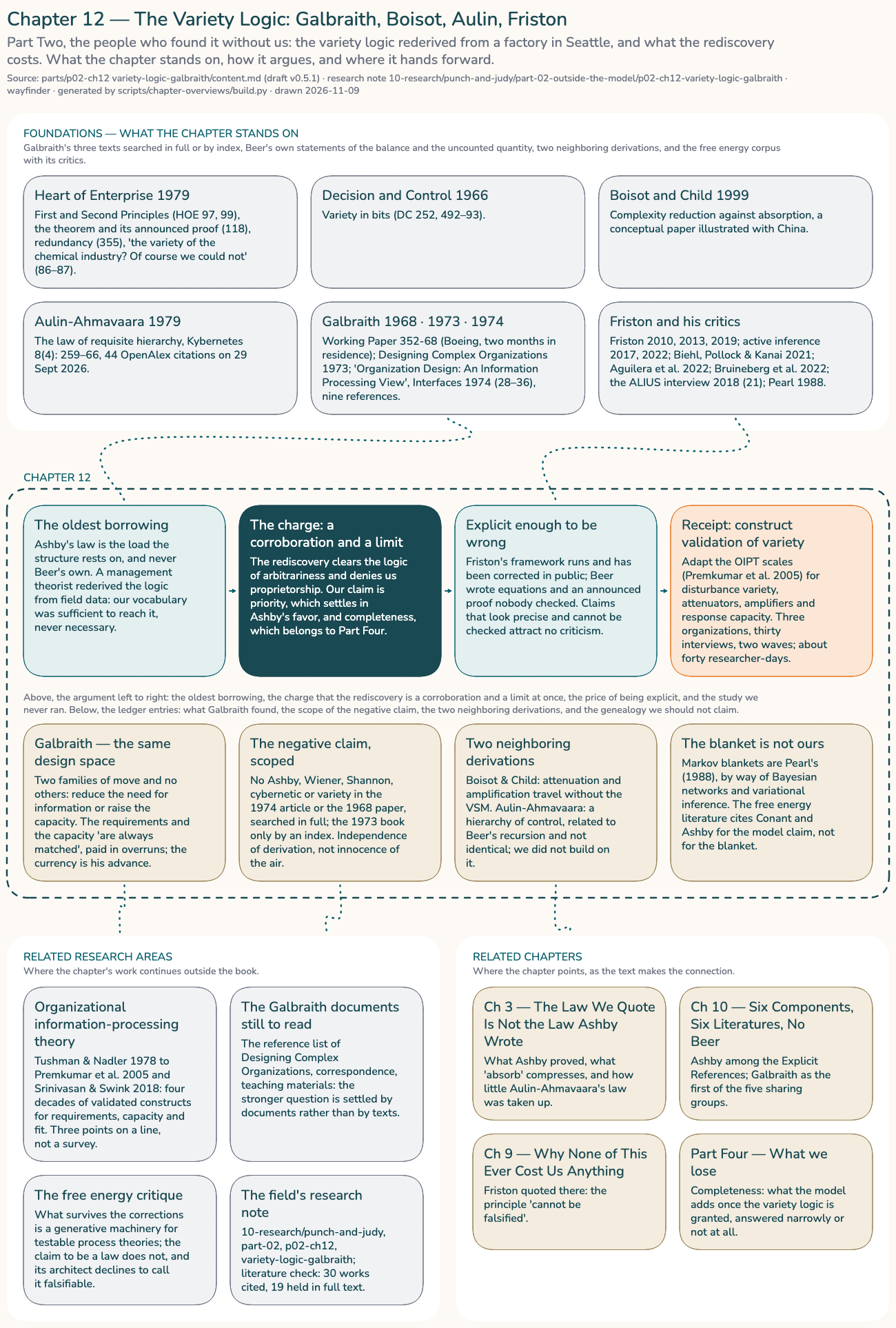
Ch 12 — The Variety Logic: Galbraith, Boisot, Aulin, Friston
Part II — Outside the model. The chapter argues that Galbraith rederived the variety logic from field data without cybernetics — which clears the model of arbitrariness while denying it proprietorship — and reads Friston’s free-energy principle as the explicit, correctable version of an ambition Beer stated but never measured.
The question
What does it cost that a management theorist reached the same two-move design space without our vocabulary, and what happens when a neighboring mathematics finally becomes explicit enough to be wrong?
The finding
Galbraith’s 1968 study inside Boeing’s Commercial Airplane Division, his 1973 book and his 1974 Interfaces paper give the same design space as attenuation and amplification, under the word uncertainty. The chapter’s searches found no Ashby, Wiener, Shannon, cybernetic or variety in the 1974 article or the 1968 working paper, and Galbraith names Herbert Simon as his guiding influence. On one point his formulation is sharper than the one usually quoted: he says the books always balance, and names the currency — schedule, budget, performance — which gives the claim an empirical shape. Three cautions are marked. The negative search is direct only for those two texts and provisional for the 1973 book, whose reference list could not be read. Absence of citation is not absence of influence. And the evidence base is a single division.
Two further arrivals sit on the same ledger. Boisot and Child (1999) distinguished complexity reduction from absorption without suggesting a dependency on Beer, in a conceptual paper. Aulin-Ahmavaara’s law of requisite hierarchy (1979) is inside cybernetics, related to Beer’s recursion and not identical with it, and little taken up.
Friston’s free-energy principle is the first attempt since Ashby to derive regulatory structure from first principles with mathematics that runs. The chapter resists calling it attenuation and amplification restated, labelling that an interpretive move. Two things follow. The apparatus runs, exposing that Beer’s claims looked precise and could not be checked. And being explicit has a price, paid publicly: technical critiques show the definitions inconsistent and the lemma, at face value, incorrect, and Friston himself declines to call the principle falsifiable. The chapter also records that Beer conceded variety cannot be counted absolutely, only matched by state generators.
What the chapter puts at risk
- Adapt established organizational-information-processing scales into a construct-validation study of disturbance variety, attenuators, amplifiers and response capacity.
- Run a pilot in three organizations — instrument design, thirty cognitive interviews and two survey waves — at roughly forty researcher-days plus participant time.
- Pre-register convergence and discriminant-validity thresholds before the first wave.
- Treat a negative result as decisive: if the proposed variety measures do not converge, stop treating “variety” as one measurable organizational quantity and specify the narrower constructs that do.
Beer locators
DC 1966: 252, 492-93; DTS 1985: 2; HOE 1979: 86-87, 97, 99, 101, 118, 217, 298, 308, 355, 565.
Status
Draft, Punch and Judy v0.5.0 — not project canon, and not published. The chapter marks the Galbraith independence finding as verified for the paper and the working paper and provisional for the 1973 book; the OpenAlex citation counts are described as a crude instrument used only for an order of magnitude; the correspondence between Friston’s belief/action duality and attenuation/amplification is labelled the authors’ interpretive move; and it states that it has not run the free-energy code and makes no claim about any particular fit. Its new Beer quotations were checked against the PDFs on 29 September 2026.
Related
Punch and Judy — Overview, Variety and regulation, Law of Cohesion, Principles and axioms of organization, Recursion, Ch 10 — Six Components, Ch 13 — The Autonomy Design