Chapter content · Overview diagram
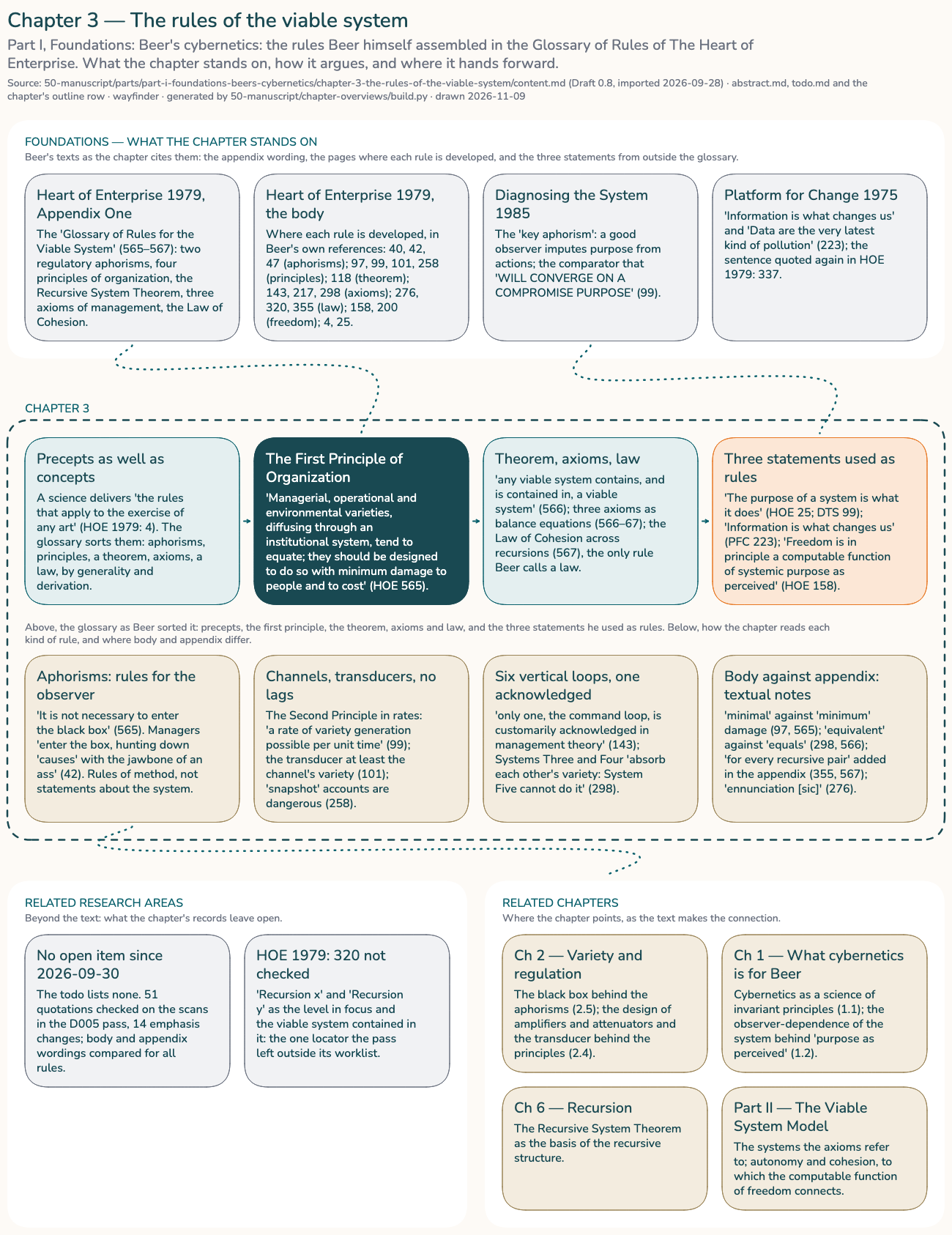
Ch 3 — The rules of the viable system
Part I — Foundations: Beer’s cybernetics. The chapter reproduces Beer’s rules in his own words and in his own order, which makes it the shortest way into the theory.
The question
What rules does Beer actually state for a viable system, in what form, and which of them does he claim as law?
The reading
The spine of the chapter is the appendix of The Heart of Enterprise, Beer’s own glossary of rules, and the chapter keeps its five kinds. Two regulatory aphorisms say that the black box need not be entered to understand the function it performs or to calculate the variety it may generate (HOE 1979: 565; developed at 40 and 47). Four principles of organization carry the design work: managerial, operational and environmental varieties tend to equate and should be designed to equate with minimum damage to people and cost (HOE 1979: 565; 97); the four directional channels must each transmit more than the originating subsystem can generate in the same time (566; 99); where a channel crosses a boundary it is transduced, and the transducer’s variety must match the channel’s (566; 101); and all three must hold cyclically, without hiatus or lag (566; 258).
The Recursive System Theorem — any viable system contains, and is contained in, a viable system (HOE 1979: 566; 118) — Beer presents explicitly as another statement of the same point he made in Brain of the Firm from the opposite angle. Then the three axioms of management: horizontal variety disposed by the operational elements equals vertical variety disposed on the six vertical components of cohesion (566; 217); the variety System Three disposes after the first axiom equals that disposed by System Four (566; 298); and the variety of System Five equals the residual variety generated by the second (567; 298). Only one rule is called a law: the Law of Cohesion for Multiple Recursions, balancing the System One variety accessible to System Three of recursion x against the metasystems of recursion y (567; 355).
Three further rules are not in the glossary but serve as rules throughout the books, and the chapter collects them: the purpose of a system is what it does (HOE 1979: 25; DTS 1985: 99, where it is the key aphorism for the observer); information is what changes us (PFC 1975: 223; HOE 1979: 337); and freedom is in principle a computable function of systemic purpose as perceived (HOE 1979: 158), which Beer calls the explosive conclusion.
Beer locators
BOTF 1981: 41, 118; DTS 1985: 99; HOE 1979: 25, 40, 47, 97, 99, 101, 118, 158, 217, 258, 298, 337, 355, 565–67; PFC 1975: 223.
Status
Draft, Pure VSM v0.8 (2026-09-23). Beer’s texts govern where the draft and they differ.
The rules are reproduced as Beer sets them in the glossary; the one textual variation is recorded rather than smoothed: the First Principle reads “with minimal damage” in the body (HOE 1979: 97) and “with minimum damage” in the appendix (565).
Related
Part I — Foundations, Ch 2 — Variety and regulation, Principles and axioms of organization, Law of Cohesion, Recursion, Variety and regulation, System Five, The Heart of Enterprise, Observer and recognition.