Chapter content · Overview diagram
Ch 20 — Usefulness Instead of Truth
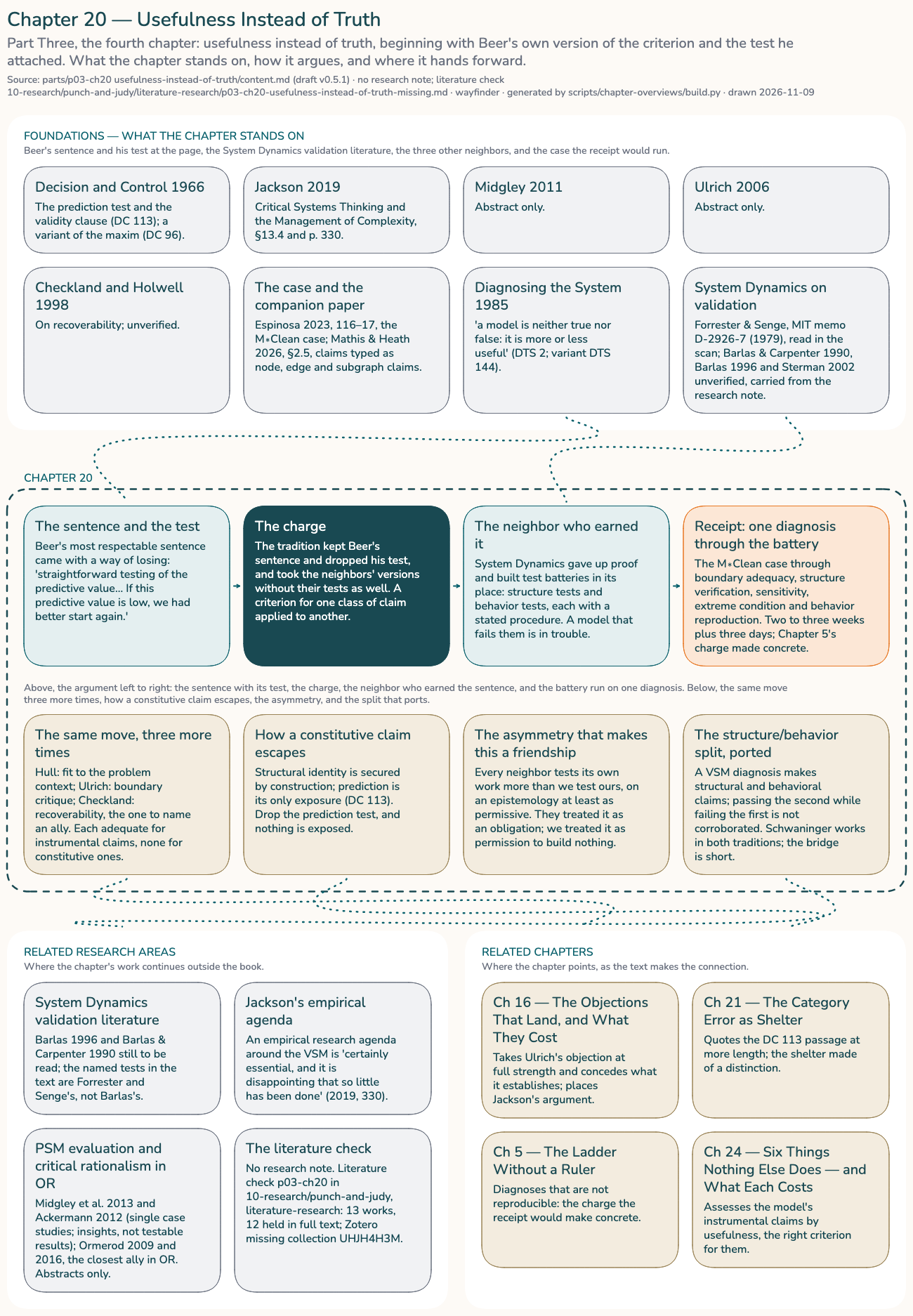
Part III — False friends and enemies. The chapter argues that the most respectable sentence in the systems literature, that a model is neither true nor false but more or less useful, is the founder’s own and came with a prediction test, and that the tradition kept the sentence and dropped the test.
The question
What happens when a criterion suited to instrumental claims is applied to constitutive ones, and the founder’s own way of losing is left unbuilt?
The finding
The chapter locates the sentence in Beer — set apart on the second page of Diagnosing the System for Organizations, with variants in Decision and Control and later in the same book — so it is not borrowed. It shows that in 1966 Beer also said how usefulness of a model is to be measured, by testing its predictive value, and that if predictive value is low “we had better start again.” The tradition, it says, kept the philosophy and dropped the test.
It then presents the neighbour that earned the position and paid for it. System Dynamics gave up proof of correctness, argued its way to confidence rather than proof, engaged Popper including the Duhem problem, and then built structured test batteries: structure tests and behaviour tests, named procedures with stated thresholds. “More or less useful” in that tradition is the conclusion of a program with named ways of losing; in ours it began with one test and became an exemption. The chapter notes the structure/behaviour split is directly portable to a VSM diagnosis, and that a companion working paper’s node, edge and subgraph typing connects to it.
The same substitution appears three more times: the Hull school judging by fit to context and practical and emancipatory results; Ulrich’s boundary critique, which is a criterion for the legitimacy of an intervention and cannot settle whether there are five subsystems; and Checkland’s recoverability, which the chapter names an ally rather than a false friend, since prior declaration is what its own receipt protocol asks for. Across all four, it argues, the substitute criterion is adequate for instrumental claims and cannot decide a constitutive one, because a false model can be useful. Beer’s 1966 account shows the escape: structural identity is secured by construction, so if the prediction test is dropped nothing is exposed.
It says plainly that the neighbours owe this tradition nothing, and that the sentence and the test both came from the founder.
What the chapter puts at risk
- Take one completed published VSM diagnosis and subject it to the System Dynamics test set in Barlas’s form, adapted minimally.
- Run boundary adequacy, structure verification, parameter and structure sensitivity, extreme-condition behaviour, and behaviour-pattern reproduction.
- Publish the battery and the result together.
Beer locators
DTS 1985: 2, 144; DC 1966: 96, 113.
Status
Draft, Punch and Judy v0.5.0 — not project canon, and not published. The chapter flags several supporting sources as unverified (Barlas and Carpenter, Barlas, Sterman, Checkland and Holwell); its System Dynamics test list is sourced to a 1979 MIT memo read in scan, with the published page unconfirmed; and it states that whether the chosen published case records enough to run every battery item has not been checked.
Related
Punch and Judy — Overview, Homomorphism, Viable System Model, Decision and Control, Diagnosing the System for Organizations, Ch 21 — The Category Error as Shelter, Ch 28 — What Would Count Against It?