Chapter content · Overview diagram
Ch 10 — Six Components, Six Literatures, No Beer
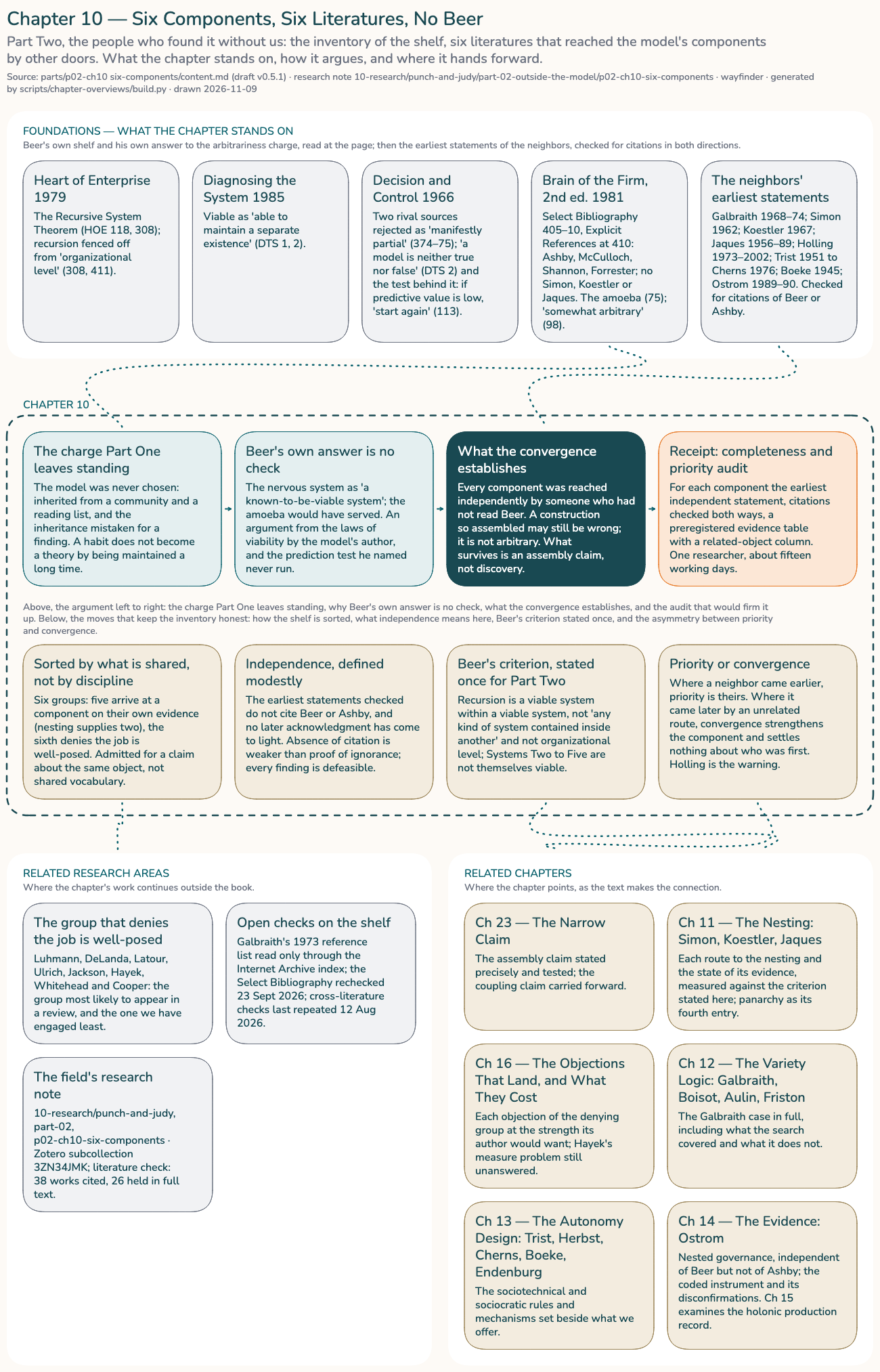
Part II — Outside the model. The chapter argues that five independent literatures reached components of the model on their own evidence, that four of these entries are convergence on a related but not identical object, and that the finding narrows the VSM’s claim from discovery to assembly.
The question
Part One leaves a charge that drawing the model more carefully cannot answer: what became of the alternatives, and was the six-part construction ever chosen rather than merely inherited?
The finding
The chapter opens on the Select Bibliography of the second edition of Brain of the Firm (1981) and its Explicit References section, which names Ashby, McCulloch, Shannon and Weaver, Forrester and others but not Simon, Koestler or Jaques. The chapter reads this as a printed list, with nothing to suggest concealment, and as evidence that at least three finders of the same components were not on the shelf when the model was assembled. Beer had an answer of his own and a concession to go with it: he called the choice of five “somewhat arbitrary,” and tied the model’s use to a prediction test the chapter notes was never run.
It then answers the charge of arbitrariness from outside the vocabulary under suspicion. Sorting the neighborhood by what each candidate shares with Beer rather than by discipline yields six groups. Five arrive at a component on their own evidence: Galbraith on variety matching; Simon and Koestler on nesting; Jaques on a criterion for managerial strata; Holling on cross-scale coupling; Trist, Herbst and Endenburg on bounded autonomy; and Ostrom on nested governance. The sixth denies that the job is well posed at all and is left to Chapter 16.
The chapter is careful about what this establishes. Independence here means that the earliest statements checked do not cite Beer or Ashby, which is weaker than proof of ignorance and is defeasible. Simon, Koestler, Jaques, Ostrom and Holling are entered as convergence on a related object, not Beer’s, since none requires each nested layer to be a viable system as his recursion does. The answer to the charge is not that the model is true because it keeps good company; it is that a construction assembled from parts six literatures found on their own is not arbitrary. It survives as an assembly claim and not a discovery claim, which Chapter 23 tests.
What the chapter puts at risk
- Commission a completeness and priority audit identifying, for each component, the earliest independent statement and checking citations in both directions — one researcher, six bounded searches, a preregistered evidence table and external spot-checking, roughly fifteen working days.
- Record for each entry whether the object reached is Beer’s (a viable system within a viable system) or a related one, so a negative result narrows the claim about nesting and not about recursion.
- If a component cannot be shown to have an independent lineage, narrow the non-arbitrariness claim to the components that survive, and print the narrowed version.
- Treat Holling as the warning that convergence after Beer is evidence of independent rediscovery, not priority.
Beer locators
BOTF 1981: xii, 75, 98, 405-10, 410; DC 1966: 113, 374-75; DTS 1985: 1, 2, 38-39, 82, 135; HOE 1979: 118, 158, 180-81, 217, 308, 336, 407, 411, 566.
Status
Draft, Punch and Judy v0.5.0 — not project canon, and not published. The chapter marks several results provisional or negative: the independence findings are defeasible; the Galbraith check is direct only for the 1974 article and 1968 working paper and rests on a full-text index search for the 1973 book, whose reference list was not read page by page; the Holling entry is convergence, not priority; the count of holonic production systems is a count of a negative; and the Select Bibliography check is a check of a printed list.
Related
Punch and Judy — Overview, Viable System Model, Recursion, System One, Variety and regulation, Law of Cohesion, Pathologies of viable systems, Ch 11 — The Nesting: Simon, Koestler, Jaques