Chapter content · Overview diagram
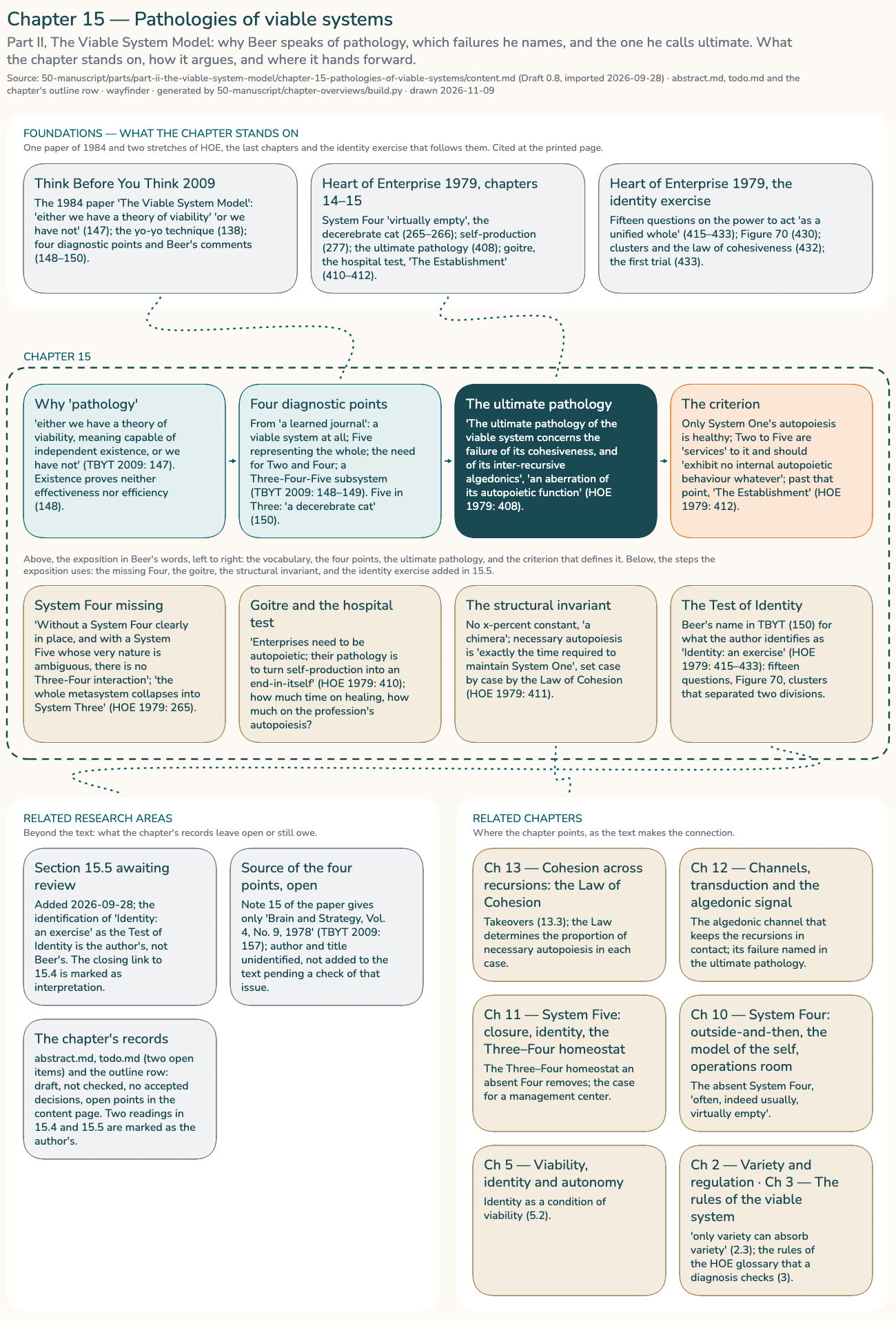
Ch 15 — Pathologies of viable systems
Part II — The Viable System Model. What a viable system looks like when it is failing: the diagnostic points Beer endorses, the collapse that takes Five back into Three, and the pathology of a system that produces itself for its own sake.
The question
If viability is a theory, what does it let one diagnose — and where does Beer think the deepest failure lies?
The reading
Beer defends the medical vocabulary on the ground that either we have a theory of viability, meaning capable of independent existence, or we have not (TBYT 2009, “The Viable System Model”: 147). Breakdowns are diagnosable in the plain sense that an inadequacy can be traced to a malfunction in one of the five subsystems, where a cybernetic feature that composes the rules is found not to be functioning (148). Existence proves nothing: the fact that an organization is there does not prove that it is effectively there, witness universities, nor efficiently there, witness hospitals (ibid.). A frequent cause, especially in social services, is the attempt to repeal the Law of Requisite Variety itself (ibid.).
The chapter then quotes four diagnostic points from a learned journal, endorsed rather than authored by Beer: whether management presides over a viable system at all; whether System Five represents the whole system to larger systems; whether managers understand the need for Systems Two and Four; and whether Three, Four and Five form a subsystem (TBYT 2009: 148–49). His comments are concrete. On takeovers: autonomy promised to acquired companies is poppycock, because the Law of Cohesion shows the new recursion inevitably takes variety from the subsidiary (149). On identity: after much adaptation, will the system still be able to recognize itself — and will others be able to recognize it (ibid.). On the collapse of Five into Three, likely because Five people have usually been promoted from Three: when something goes wrong they dive down into the problem they understand so well and never emerge again, leaving a decerebrate cat that responds reactively from the autonomic command centres, incapable of planning and foresight and of will and judgment (150; HOE 1979: 266). On Three–Four–Five: the case for a management centre, where that metasystem has a chance to find its own cohesion (150). Without a System Four clearly in place, and with a System Five whose nature is ambiguous, there is no Three–Four interaction and no Five monitoring of it (HOE 1979: 265).
The last movement is the deepest. Beer takes Maturana and Varela’s autopoiesis and shifts the emphasis: the primary characteristic of a viable system is not the power of self-reproduction but of self-production (HOE 1979: 277), and autopoiesis is the final testimonial to viability (405). Enterprises need to be autopoietic; their pathology is to turn self-production into an end in itself (410). The criterion is that only System One should be autopoietic: Systems Two to Five are services to System One’s autopoiesis and should exhibit no internal autopoietic behaviour whatever — and it is precisely when they do, and the whole becomes pathologically autopoietic, that people start to talk about “The Establishment” (412). The ultimate pathology is thus a failure of cohesiveness and of inter-recursive algedonics, an aberration of the autopoietic function (408).
Beer locators
HOE 1979: 265–66, 277, 403–14, 415–433; TBYT 2009, “The Viable System Model”: 147–50.
Status
Draft, Pure VSM v0.8 (2026-09-23). Beer’s texts govern where the draft and they differ.
Checked: the HOE and TBYT quotations were checked against the scans; the closing link between the alarm passages and §15.4 is marked in the chapter as the author’s interpretation.
Open points
- The source of the four diagnostic points is not identified: the note number is 15, and reference 15 of the paper reads Brain and Strategy 4(9), 1978, with no author or title given. It is not added to the chapter text pending a check of that issue.
- “Test of Identity”, mentioned in TBYT 2009: 150, does not exist as a text in HOE; the chapter identifies it as “Identity: an exercise” (HOE 1979: 415–433) and reports it in a new §15.5, added for review.
Related
Part II — The Viable System Model, Ch 14 — Diagnosis, Pathologies of viable systems, System Three, System Five, System Four, Law of Cohesion, The Heart of Enterprise, Think Before You Think.