Chapter content · Overview diagram
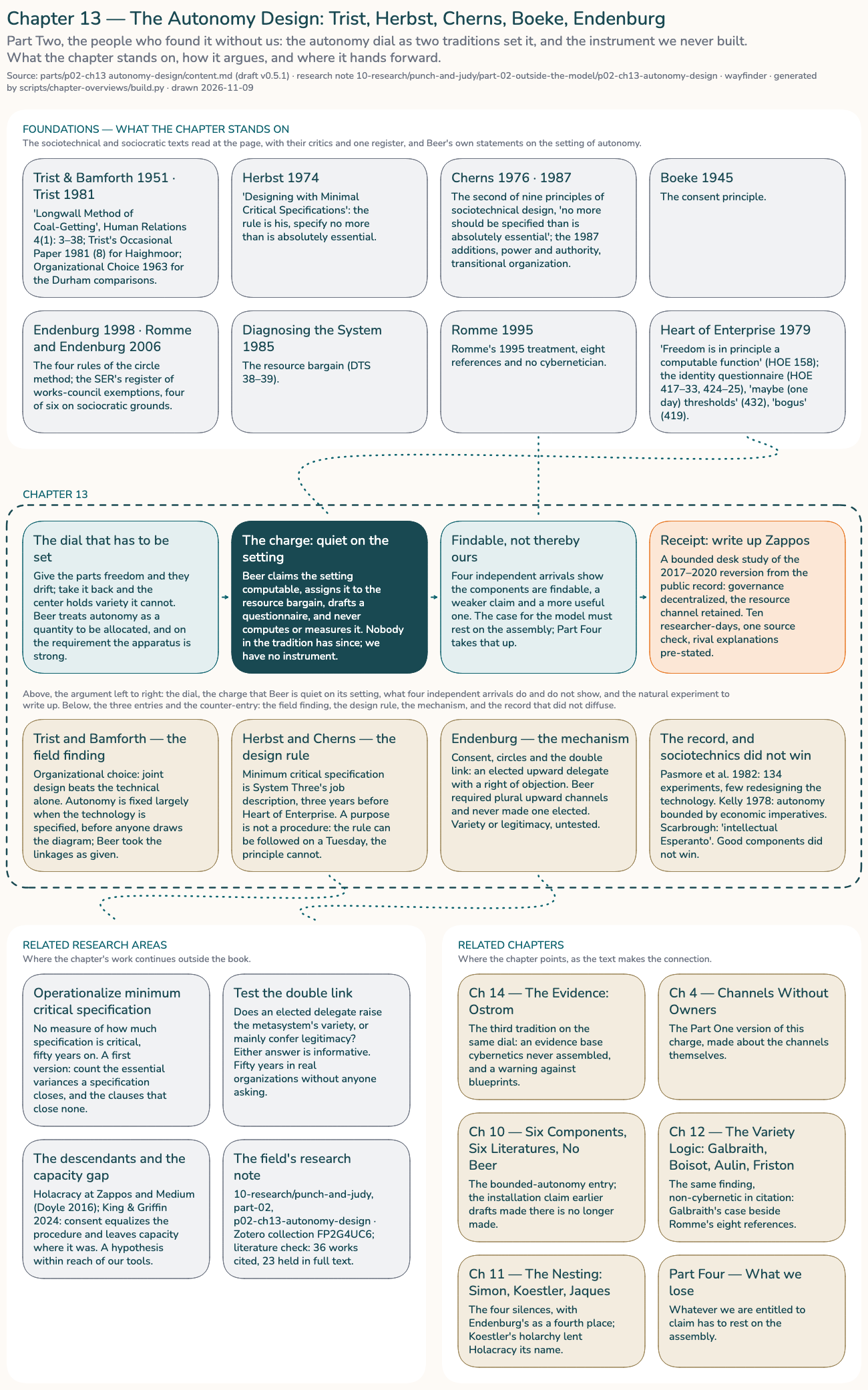
Ch 13 — The Autonomy Design: Trist, Herbst, Cherns, Boeke, Endenburg
Part II — Outside the model. The chapter argues that Beer claims the setting of autonomy is determinate and assigns it to the resource bargain, but never computes or measures it, while two traditions outside cybernetics supply a design rule and a working mechanism at exactly that point.
The question
Where outside cybernetics was the autonomy–cohesion dial set, and what do those settings cost the model’s own claim to specify it?
The finding
Trist and Bamforth’s 1951 coal-face paper makes autonomy a property of the work system, designed in or out before anyone draws a diagram — the chapter calls this a change of category rather than of belief. Herbst’s minimum critical specification (1974), named and systematized by Cherns (1976), is a rule of construction where Beer’s principle of autonomy is a constraint on outcomes; Cherns later added power and authority and transitional organization, the two things such designs most reliably fail on. The tradition’s record is mixed: Pasmore and colleagues’ 1982 review of a hundred and thirty-four experiments indicts itself for rarely redesigning the technology, Kelly (1978) offers a rival explanation, and the tradition died without being refuted. Beer wrote that the loss of autonomy is already implicit in the total system, but treated the operational linkages as given; at a coal face they are designed.
Endenburg’s sociocratic circle method supplies four rules, and the double link is the sharpest mechanism — it adds election and consent to a channel structure Beer required plural but never made elected. The Dutch Social and Economic Council accepts full sociocratic implementation as a ground for works-council exemption, the strongest hard fact and a legal one, and the single-figure count caps the claim. The descendants are where the evidence is uncomfortable: Zappos, which the chapter reads as a reported System Three failure, and Medium, which breached Cherns’s second principle. A 2024 study of a co-housing community finds that formal equality does not redistribute capacity. The chapter also corrects an earlier draft: no figures support the claim that sociocracy is installed in more organizations than the VSM, and nobody counts either.
What the chapter puts at risk
- Operationalize minimum critical specification — a procedure for counting the essential variances a specification must close and identifying the clauses that close none.
- Test the double link: does an elected upward delegate raise the metasystem’s variety, or mainly confer legitimacy?
- Write up the Zappos natural experiment from the documentary record — a bounded desk study of the 2017–2020 reversion, at about ten researcher-days plus a legal/source check, with rival explanations pre-stated.
Beer locators
BOTF 1981: 53; DTS 1985: 38-39, 82, 84; HOE 1979: 142, 143, 152, 157-58, 160, 173, 180-81, 200, 263-64, 340, 344, 407, 417-33, 419, 424-25, 432; BD 1994: 149.
Status
Draft, Punch and Judy v0.5.0 — not project canon, and not published. The manuscript marks the Beer locators in this chapter as taken from Pure VSM and not yet checked against the PDFs. It also flags: the Scarbrough “intellectual Esperanto” sentence as unverified against the paywalled text; the Hsieh remark as secondhand with no interview or date; the sociocratic and VSM adoption figures as unaudited, with the SER register dated September 2026; and the Zappos outcome as an agreement between a prediction and a report that nobody has turned into a finding.
Related
Punch and Judy — Overview, Recursion, System One, System Three, Viability, identity and autonomy, Principles and axioms of organization, Ch 12 — The Variety Logic: Galbraith, Ch 14 — The Evidence: Ostrom