Chapter content · Overview diagram
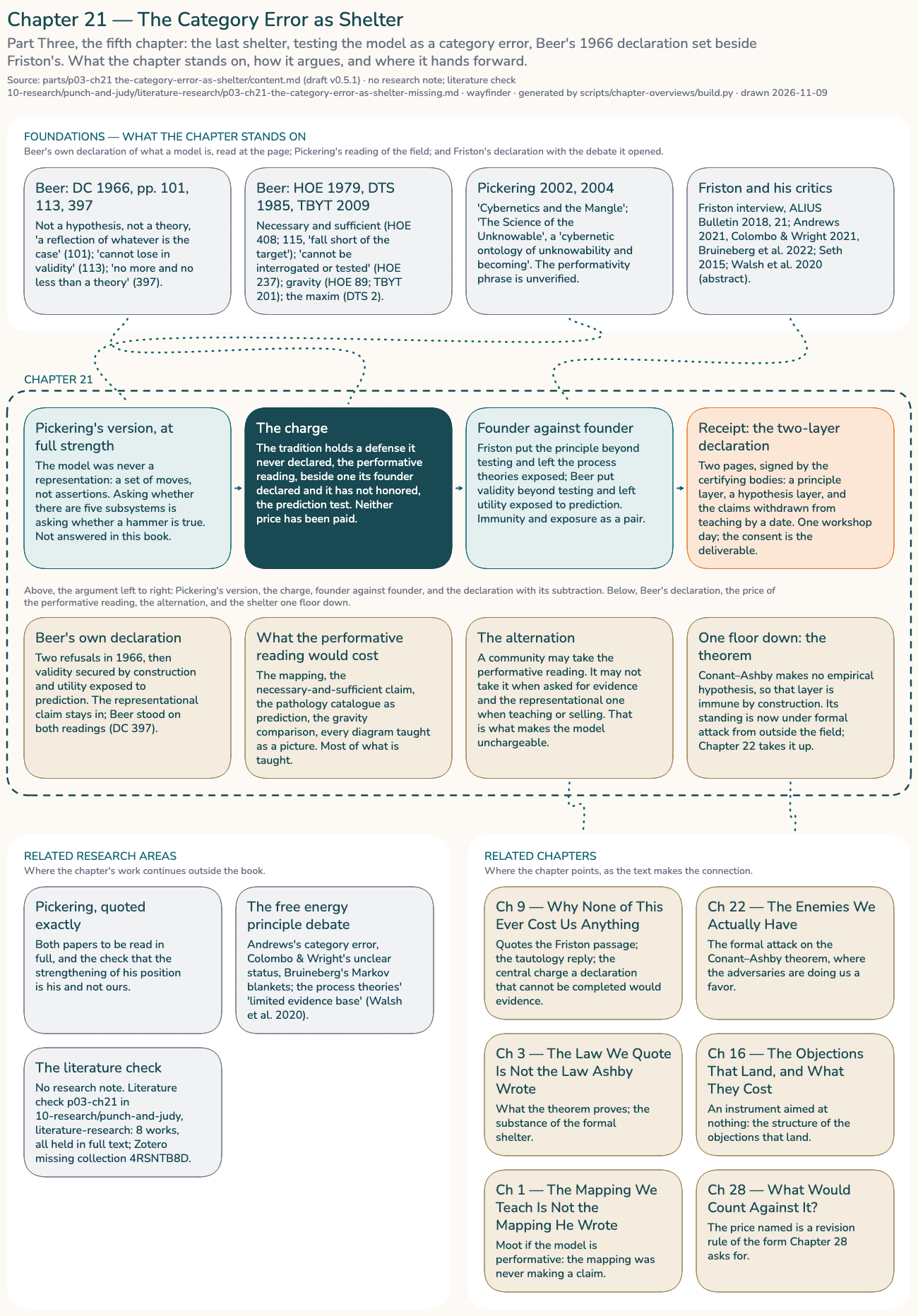
Ch 21 — The Category Error as Shelter
Part III — False friends and enemies. The chapter argues that the strongest reply to a request for a test — that the request mistakes what kind of thing the model is — deserves to be stated at full strength, priced, and set beside a neighbouring tradition that made the same argument in public and paid what it costs.
The question
If the model is not the kind of thing that can be tested, what exactly does that cost the tradition that says so, and has it ever declared the price?
The finding
The chapter gives Pickering’s reading at full strength: cybernetics as a shift from representation to performativity, Beer’s work displaying an ontology of unknowability, so that asking whether there really are five subsystems is like asking whether a hammer is true. It notes that Beer’s own practice is recognizable in that account, but also that even in his most practice-minded pages he asks that models be open to checking, writing that a manager’s implicit model fails because it “cannot be interrogated or tested.”
It then sets out a declaration by the founder in two layers. In Decision and Control Beer refused to equate the model with a scientific hypothesis or a theory, and twelve pages later said validity is secured by construction — a model that loses utility “cannot lose in validity” — while utility is measured by predictive testing. Nineteen years on the same status reached practitioners as the maxim that a model is more or less useful. The chapter observes that Beer stood on both readings, calling his enterprise-control model, the VSM’s precursor, a descriptive account of how enterprises actually work.
The price of the performative reading is high, and the chapter itemises the subtraction: the neuroanatomical mapping, the necessary-and-sufficient claim, the pathology catalogue as prediction, the Ashby–gravity comparison, and every diagram taught as a picture of how organizations are. A community may take the performative reading, it says, but not take it when asked for evidence and the representational reading when teaching, selling or citing; that alternation is what makes the model unchargeable, and the list of subtractions is itself the revision rule the book asks for elsewhere.
The comparison is founder against founder. Asked directly, Friston answered that the free energy principle cannot be falsified, like Hamilton’s principle, while hypotheses about predictive coding are hypotheses: an immunity paired with an exposure. Friston’s community took the exposure, and its process theories are being tested; ours kept the immunity, left the prediction test unbuilt, and invokes the immunity only when asked. The chapter adds that the Conant–Ashby borrowing is immune by construction and that the theorem’s own standing is now under formal attack, which the next chapter takes up.
What the chapter puts at risk
- Publish a two-page two-layer declaration, signed by the certifying bodies, dividing the model into a principle layer and a hypothesis layer.
- Attach the list of claims that must be withdrawn from teaching and client-facing material, with a date by which the withdrawal takes effect.
- Accept that the exercise cannot be completed without someone giving something up, and that completion is the deliverable.
Beer locators
DC 1966: 101, 113, 397; DTS 1985: 2; HOE 1979: 115, 237, 408; TBYT 2009: 201.
Status
Draft, Punch and Judy v0.5.0 — not project canon, and not published. The chapter marks Pickering’s phrase “from epistemology to ontology” as carried from a research note, not from the abstract and not read in full text; several free-energy-principle criticisms are flagged unverified from abstract-level notes; and it states that it has no argument that Pickering is wrong, that the performative reading has been neither refuted nor accepted.
Related
Punch and Judy — Overview, Principles and axioms of organization, Homomorphism, Decision and Control, Law of Cohesion, Ch 20 — Usefulness Instead of Truth, Ch 22 — The Enemies We Actually Have