Chapter content · Overview diagram
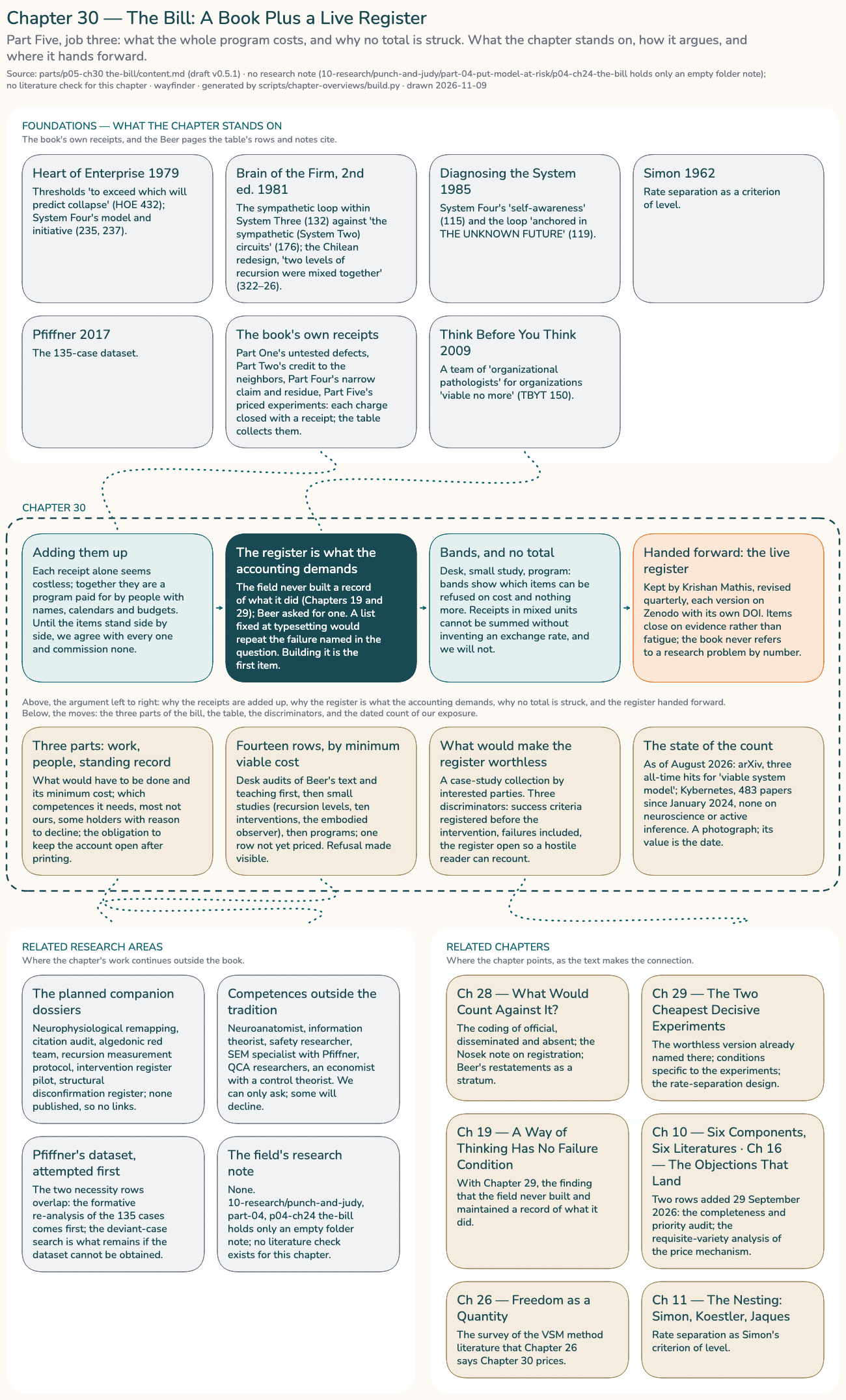
Ch 30 — The Bill: A Book Plus a Live Register
Part V — What’s at Risk in the VSM. The manuscript’s Chapter 30 sets out what the whole program costs, orders its items by minimum viable cost, and argues that the account must be kept in a maintained, versioned register rather than a printed list.
The question
What does the program cost, and who could pay and do it?
The finding
The chapter opens from the receipts of the whole book — an audit here, an analyst-week there, a review paper, a session, an archive fee — each small enough alone to seem costless, and argues that read together they are a program that must be paid for by people with names, calendars and budgets. The bill has three parts, and only the first is money: the work and its minimum cost; the people, most of whose competences are not held inside the tradition; and the standing record that keeps the account open after the book is printed.
The complete program is not printed. The chapter says it belongs in a maintained, dated and versioned companion register — the live register of the title — and that the accounting, not convenience, made that decision: the field never built and maintained a record of what it did, and Beer asked for one, so a numbered list fixed at typesetting would repeat, in the answer, the failure named in the question. Three further reasons are given. The accounting concerns more than fifty years that have already happened and does not decay, whereas an agenda decays as soon as the work is done; a printed chapter cannot record its own success, while a register can show a problem closed, by whom and with what result; and a register is the only part of the book a reader can act on rather than assent to. The book therefore never refers to a research problem by number, since numbers belong to the register and will change. The register is kept by Krishan Mathis and revised quarterly, each version deposited on Zenodo with its own DOI.
Three strict discriminators are set for the register, none expensive and each uncomfortable: success criteria registered before the intervention, failures included, and the register open so that a hostile reader can recount. Below them the chapter prints the bill: fourteen items ordered by minimum viable cost, each naming the claim at risk, the experiment, the evidence required, the cost band, the result that would count against the authors, the threatened assumption, who could do it, and a planned companion dossier. Costs are bands — desk (weeks of documentary work), small study (one organization or a bounded corpus) and program (multiple cases, specialist collaboration or longitudinal access), with some items combined and one not yet priced. Two rows on necessity overlap: the formative re-analysis of Pfiffner’s dataset is attempted first, and the deviant-case search is what remains if the dataset cannot be obtained.
No total is struck, the chapter says, because the earlier receipts are in mixed units and the bands are a third unit again, so the components cannot be summed without inventing an exchange rate; it declines, since “printing a figure we cannot defend would be a worse fault than printing none”. Whether any item happens will be decided in the column naming who could do it, where most competences lie outside the tradition. The chapter also prints a dated state of the count (an as-of box, August 2026, giving arXiv and Kybernetes search figures), calling such a count a photograph whose value is the date on it. It closes on what the authors say they owe: the work at the cheap end, the three discriminators to anyone asked to take an item, the register an owner and a cadence — which it now has — and results that go against them the same treatment as those that do not.
What the chapter puts at risk
Chapter 30 carries no closing receipt of its own and, deliberately, strikes no total; it aggregates the receipts printed elsewhere in the book. What it puts at risk is the book’s, priced:
- The work — fourteen items banded desk, small study or program (one not yet priced), each with the result that would count against the authors.
- The people — the competences the items require, most of them held outside the tradition, which the authors cannot commission.
- The standing record — the live register, with an owner, a quarterly cadence and a DOI per deposited version.
Beer locators
BOTF 1981: 129, 132, 176, 322–26, 323; DTS 1985: 115, 119; HOE 1979: 235, 237, 352, 432; TBYT 2009: 150.
Status
Draft, Punch and Judy v0.5.0 — not project canon, and not published. The costs are bands rather than quotations, and no total has been struck. Every item in the bill is a proposal: none has been run. The as-of box is dated August 2026 and says both searches will be wrong before the book is old. The completeness-and-priority audit and the survey of the VSM method literature were both added on 29 September 2026. The two necessity rows overlap and are sequenced, the formative re-analysis first. The chapter states that most of the competences listed are not held inside the tradition and that it can only ask, expecting some holders to decline. The live register is described as planned; no dossier is published.
Related
Punch and Judy — Overview · Ch 28 — What Would Count Against It? · Ch 29 — The Two Cheapest Decisive Experiments · Viable System Model · Stafford Beer · Think Before You Think · Viability, identity and autonomy