Chapter content · Overview diagram
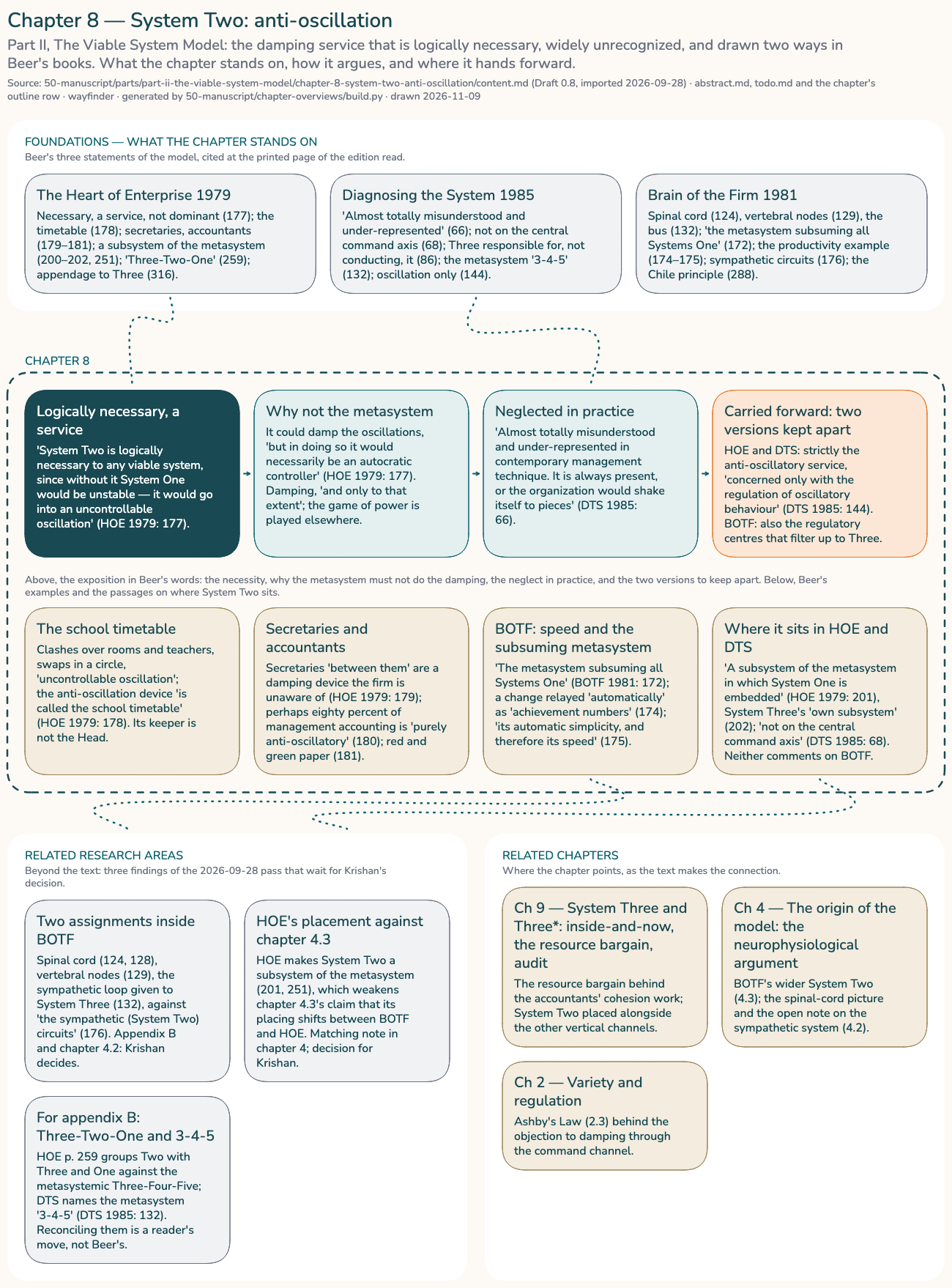
Ch 8 — System Two: anti-oscillation
Part II — The Viable System Model. The smallest of the five systems and the one most often mistaken for something larger: whatever keeps the operational units from shaking each other apart.
The question
What is System Two for — and why does Beer reduce it to a single function?
The reading
System Two is logically necessary to any viable system, since without it System One would be unstable and go into an uncontrollable oscillation (HOE 1979: 177). Its function is “the highly specific function of damping oscillations, and nothing else”, which is why Beer calls it a service to System One rather than a part of the command structure (ibid.). His standard example is the school timetable: those in the System Two role are often accused of destroying horizontal variety, whereas their proper function is merely anti-oscillatory (HOE 1979: 178).
In Diagnosing the System for Organizations the neglect is stated as a finding about management practice: System Two is almost totally misunderstood and under-represented in contemporary technique, and yet it is always present, or the organization would shake itself to pieces (DTS 1985: 66).
Brain of the Firm gives System Two a larger reach. There it is “the metasystem subsuming all Systems One” (BOTF 1981: 172), and its task is to relay a change in one division’s productivity automatically to the others, as a statistical statement couched in achievement numbers, so that oscillation does not set in (BOTF 1981: 174). The later books keep the function and narrow the placing — which is the open point below.
Beer locators
BOTF 1981: 124, 128–29, 132, 172, 174, 176; DTS 1985: 66, 132; HOE 1979: 177–78, 200–02, 251, 259.
Status
Draft, Pure VSM v0.8 (2026-09-23). Beer’s texts govern where the draft and they differ.
Checked: the HOE and DTS passages were read in the text layer and the quotations checked against the scans.
Open points
- Two placements inside Brain of the Firm. The chapter reports both: System Two as the analogue of the spinal cord and column (124, 128), and as the sympathetic circuits whose trunk links the vertebral nodes of System Two (129, 176) — while p. 132 assigns the sympathetic loop to System Three. Whether this difference belongs in appendix B, and whether chapter 4.2 should mention it, is a decision.
- Whether HOE or DTS comment on the BOTF placing of System Two as subsuming all Systems One: neither book comments on that sentence. HOE makes System Two a subsystem of the metasystem (201, 251) and System Three’s own subsystem (202), and p. 259 groups Two with Three and One against the metasystemic Three–Four–Five — which weakens the claim in chapter 4.3 that its placing shifts between the books.
Related
Part II — The Viable System Model, Ch 7 — System One, Ch 9 — System Three and Three*, System Two, Variety and regulation, Viable System Model, Brain of the Firm, The Heart of Enterprise, Diagnosing the System for Organizations.