Chapter content · Overview diagram
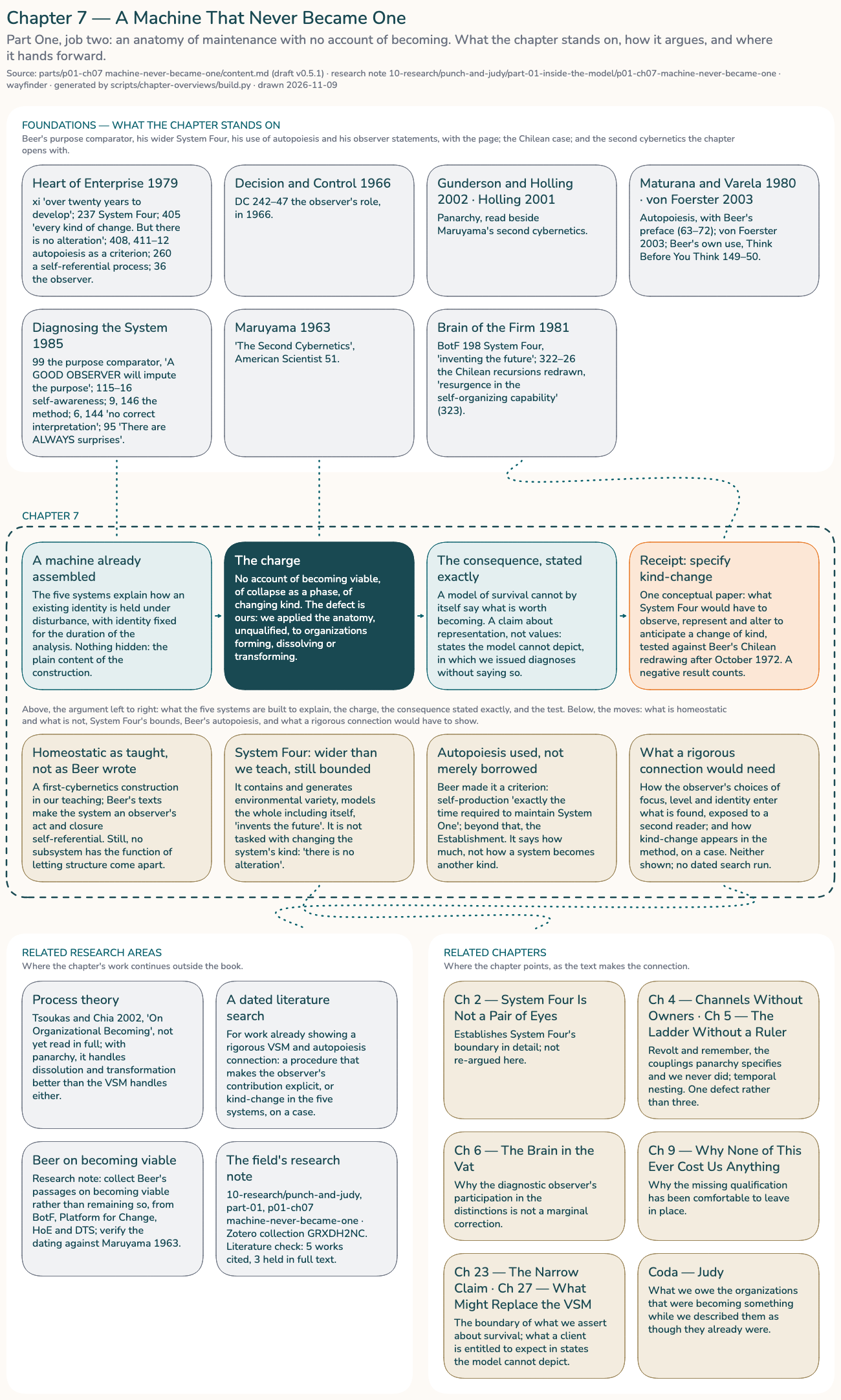
Ch 7 — A Machine That Never Became One
Part I — Inside the model. The manuscript argues that an anatomy of maintenance was applied, without qualification, to organizations that were forming, dissolving or transforming — objects the model was never framed to depict.
The question
Can the model represent an organization becoming a different kind of thing, not merely changing in its environment?
The finding
The chapter distinguishes the model’s strength from its range. The five systems explain how an existing identity is maintained under disturbance; they do not explain how a system becomes viable, passes through collapse as a phase, or changes its kind. The manuscript is careful that an anatomy of maintenance is not defective for being one: a model that explains how identity is held under disturbance has done something difficult and useful. The defect it names is ours — that we applied the model, without qualification, to startups, to institutions dismantling themselves, and to bodies that came out of an intervention as a different kind of thing.
It notes the model is a first-cybernetics, homeostatic construction, even though Beer’s own texts make the system an observer’s act and closure self-referential. Beer took autopoiesis into The Heart of Enterprise as a diagnostic criterion (a system’s self-production should take exactly the time to maintain System One; Systems Two to Five “should exhibit no internal autopoietic behaviour whatever”) — a use of the concept, but one that says nothing about becoming another kind of system. On the observer’s role, Beer went part of the way, stating it in 1966 and comparing members’ perceptions, but gave no procedure exposing the analyst’s own choices of focus and level to a second reader, and no representation of kind-change. The manuscript records that it has not run and reported a dated search of the literature for work that might already show either.
Beer’s own record contains one such state: the resurgence of self-organizing capability in Chile after October 1972, which he handled by redrawing the recursions after the event — the method catching up with the change, not representing it while it happened.
What the chapter puts at risk
- Receipt — specify kind-change. Write one paper stating what System Four would have to observe, represent and alter in order to anticipate a change in the system’s kind rather than a change in its environment. Price: one conceptual paper tested against at least one documented transformation, beginning with Beer’s own redrawing of the Chilean recursions after October 1972.
- If no operational distinction can be made, the negative result is that the extension adds vocabulary but no diagnostic power — worth knowing and publishing, because it would tell us the limitation is structural.
Beer locators
HOE 1979: xi, 36, 237, 260, 277, 405, 408, 410, 411–12; BOTF 1981: 144, 198, 264, 322–26, 323, 410; DTS 1985: 4, 6, 9, 95, 99, 115–16, 130, 144, 146; DC 1966: 242–47; TBYT 2009: 149–50; Beer’s preface to Maturana and Varela, Autopoiesis and Cognition (1980), 63–72, at 67, 70.
Status
Draft, Punch and Judy v0.5.0 — not project canon, and not published. The literature search for an existing procedure or representation has not been run and reported. The kind-change specification is proposed work. The second-order and autopoiesis vocabulary is described as situating the tradition without, by itself, demonstrating an account of becoming.
Related
Viability, identity and autonomy, System Four, Observer and recognition, Viable System Model, Punch and Judy — Overview, Ch 5 — The Ladder Without a Ruler, Ch 6 — The Brain in the Vat, Ch 9 — Why None of This Ever Cost Us Anything