Chapter content · Overview diagram
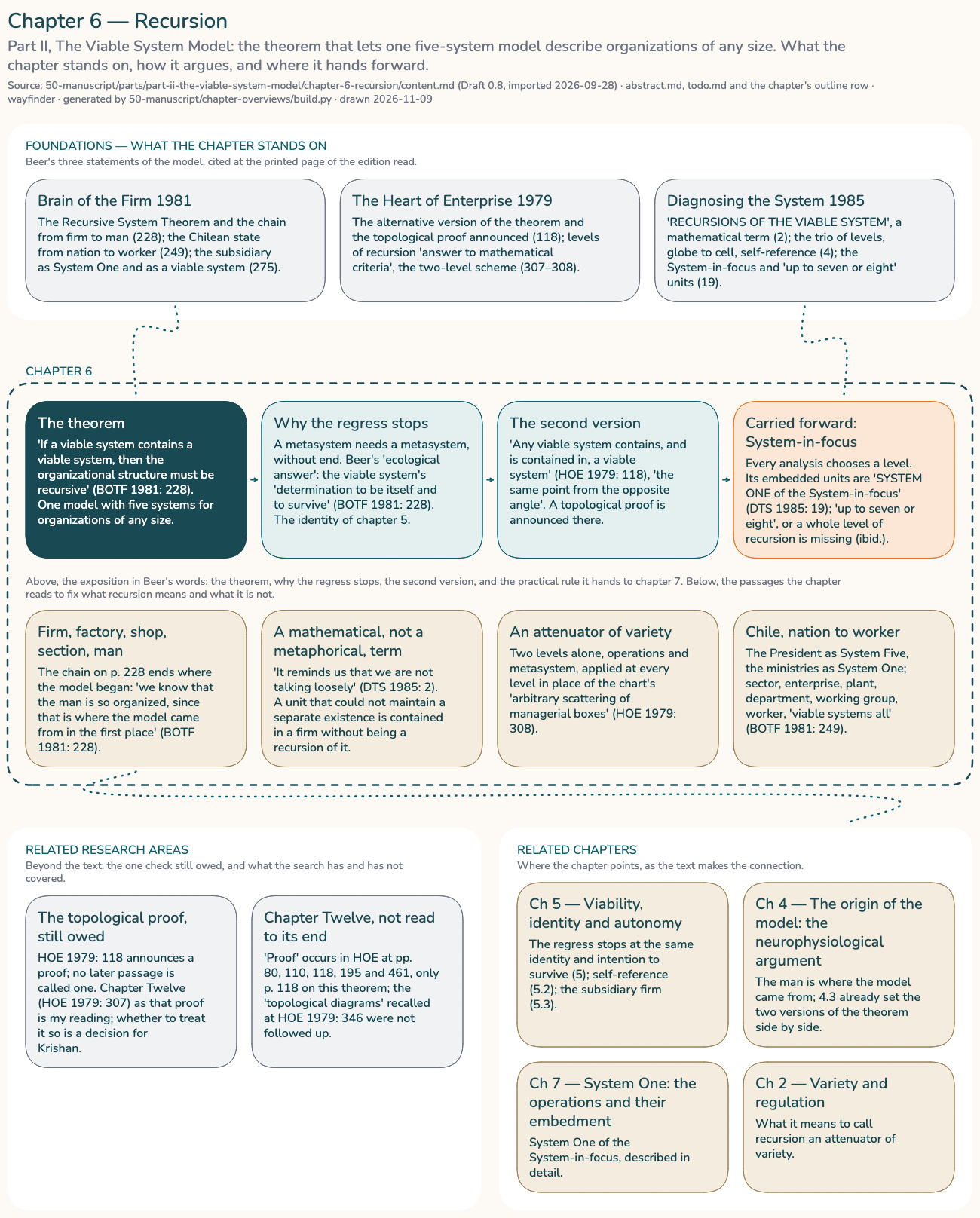
Ch 6 — Recursion
Part II — The Viable System Model. The theorem that makes the model scale: every viable system contains viable systems, and the level at which an analysis is made is chosen rather than found.
The question
What does it mean that a viable system contains viable systems — and why does Beer insist that “recursion” is a mathematical term rather than a metaphor?
The reading
Beer states the theorem first in Brain of the Firm, once the model of the firm has been reproduced inside its own units: if a viable system contains a viable system, then the organizational structure must be recursive (BOTF 1981: 228). Its force there is that it validates the five-tier hierarchy he has been using throughout — if the viable firm is organised like this, so is its major viable unit. The Heart of Enterprise states the same relation from the other end: in a recursive organizational structure, any viable system contains, and is contained in, a viable system (HOE 1979: 118), a version Beer himself calls the alternative phrasing of the first.
The word is borrowed deliberately. Diagnosing the System for Organizations takes the mathematical term because, while its meaning in context is evident, it reminds the reader that nothing loose is meant (DTS 1985: 2). In The Heart of Enterprise the levels are said to answer to mathematical criteria, and a precise definition of the viable system is described as a vast attenuator of the variety of organizational description (HOE 1979: 308).
The Chile chapters show the theorem at work on a state. The government is embedded in the nation and should be conceived as a viable system whose System Five is the President and whose System One is the headquarters of each major function — health, education, finance, industry; industry in turn is a viable system with the Minister of Economics as its Five and the industrial sectors as its One (BOTF 1981: 249).
What the theorem forces on any analysis is a choice. Diagnosing the System for Organizations calls the system chosen the System-in-focus and its embedded units System One of that focus (DTS 1985: 19). Beer’s rule of thumb is up to seven or eight such units — not many more, he hopes, or else a whole level of recursion may be missing (ibid.). The level is therefore an act of the observer, which is the point chapter 1 made about systems generally.
Beer locators
BOTF 1981: 228, 249; DTS 1985: 2, 19; HOE 1979: 118, 307–08, 346.
Status
Draft, Pure VSM v0.8 (2026-09-23). Beer’s texts govern where the draft and they differ.
Checked in the 2026-09 pass: the HOE text layer was searched for “proof” and “topological”; only p. 118 refers to the Recursive System Theorem, and no later passage is called the proof.
Open points
- The topological proof announced at HOE 1979: 118 is not discussed in this chapter. Chapter Twelve of HOE (307–08) sets out the isomorphic mapping between levels and Beer recalls “topological diagrams of the last chapter” at 346, but whether that chapter should be treated here as the proof is a decision for Krishan — its argument was not read to the end.
Related
Part II — The Viable System Model, Ch 5 — Viability, identity and autonomy, Ch 7 — System One, Recursion, Law of Cohesion, Observer and recognition, Brain of the Firm, Diagnosing the System for Organizations, Cybersyn.