Chapter content · Overview diagram
Ch 16 — The Objections That Land, and What They Cost
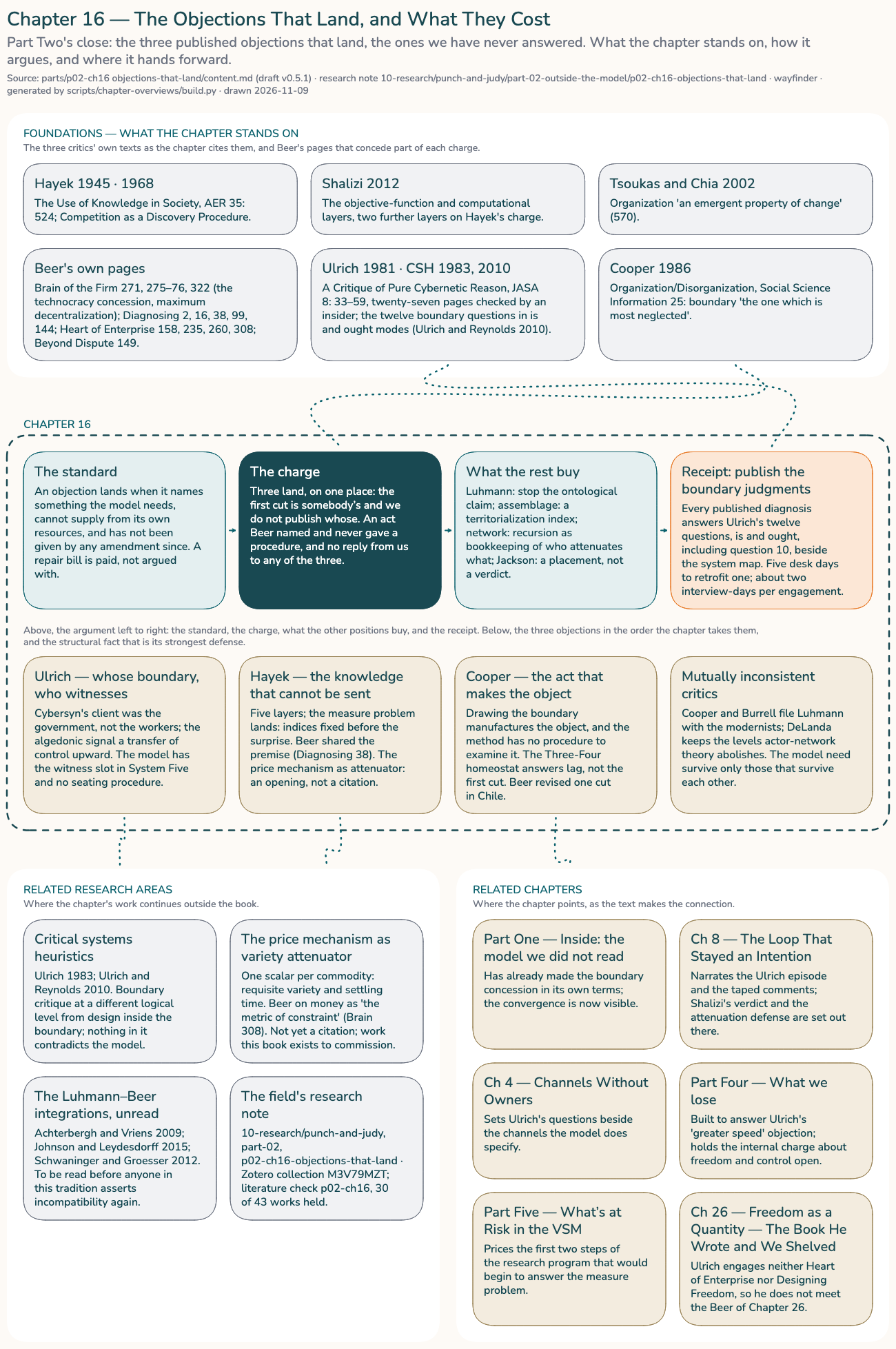
Part II — Outside the model. The chapter argues that Ulrich’s, Hayek’s and Cooper’s objections all land on the same first act — the drawing of a boundary — which Beer named, revised once in public and never gave a procedure for.
The question
Which published objections land, by a standard narrow enough to be stated, and what do the ones that do not land cost instead?
The finding
An objection lands, on the chapter’s stated standard, when it identifies something the model needs in order to do the job it claims, cannot supply from its own resources, and no amendment since has supplied. Three land, and they turn out to be one wound seen from three directions: Ulrich’s critical-systems-heuristics charge, asking whose boundary judgments are in force and who witnesses those affected but not involved; Hayek’s measure problem, that preselected indices cannot certify the surprises nobody selected for; and Cooper’s point, that drawing the boundary is the act that manufactures the object and the act the method supplies no procedure to examine. The chapter notes that Hayek’s measure problem and Ulrich’s third question are the same question asked by two hostile literatures, which makes it load-bearing.
Beer’s concessions and defenses are recorded: the design was meant to be maximum decentralization; he conceded the participatory design was not always kept; he named the observer’s act as the first cut, made it the workbook’s first task and revised one in print. The chapter states plainly that beyond Beer’s own five pages the reply to Ulrich was ours to write and we did not write it, and that the measure-problem layer stands unanswered, with only a research program that would begin to constitute one.
The remaining positions do not land in their usual form and each converts into an amendment: Luhmann’s operational closure lands against an ontology, not a design language, and the integration work already exists; DeLanda’s assemblage theory buys a territorialization index; actor-network theory buys demoting recursion from a ladder of being to a record of who attenuates what for whom; Jackson’s classification is a placement, not a verdict; and process philosophy, minus Cooper’s boundary point, describes a problem the Three-Four homeostat was built for. The chapter notes the positions are mutually inconsistent, so the model need only survive whichever of them survive each other.
What the chapter puts at risk
- Require every published diagnosis to answer Ulrich’s twelve questions in both is and ought modes, including question 10, and to publish the boundary judgments beside the system map.
- Retrofitting one completed diagnosis is a five-day desk exercise; adding the protocol prospectively is roughly two interview-days per engagement.
- If competent analysts cannot answer the questions from the engagement record, treat the diagnosis as not reproducible enough to support its boundary claims.
- If the answers expose affected parties without a witness role, record that as a defect rather than hide it in the system boundary.
Beer locators
BOTF 1981: 163, 228, 245–46, 263, 264, 270, 271, 275, 276, 283, 308, 312–13, 322–26, 328, 339, 394; DC 1966: 113, 139, 242, 243, 246; DTS 1985: 1, 2, 16, 38, 86, 99; HOE 1979: 158, 200, 235, 260, 263–64, 308, 351; PFC 1975: 159; TBYT 2009: 69; BD 1994: 149–59.
Status
Draft, Punch and Judy v0.5.0 — not project canon, and not published. The manuscript marks the Beer locators in this chapter as taken from Pure VSM and not yet checked against the PDFs. It also flags: Cooper’s sharper formulation as the authors’ compression of his argument rather than a quotation; Beer’s published 1983 reply to Ulrich as not yet read; the Jackson grid’s coercive column as not fixed to a primary source; the Shalizi, Corporate Rebels and Espinosa material as blog- or abstract-sourced; and that its three landing objections are one defect and the receipt at the chapter’s end buys only the first of the three wounds.
Related
Punch and Judy — Overview, Recursion, System One, System Five, Algedonic signal, Observer and recognition, Cybersyn, Ch 15 — The Thirty-Year Experiment