Chapter content · Overview diagram
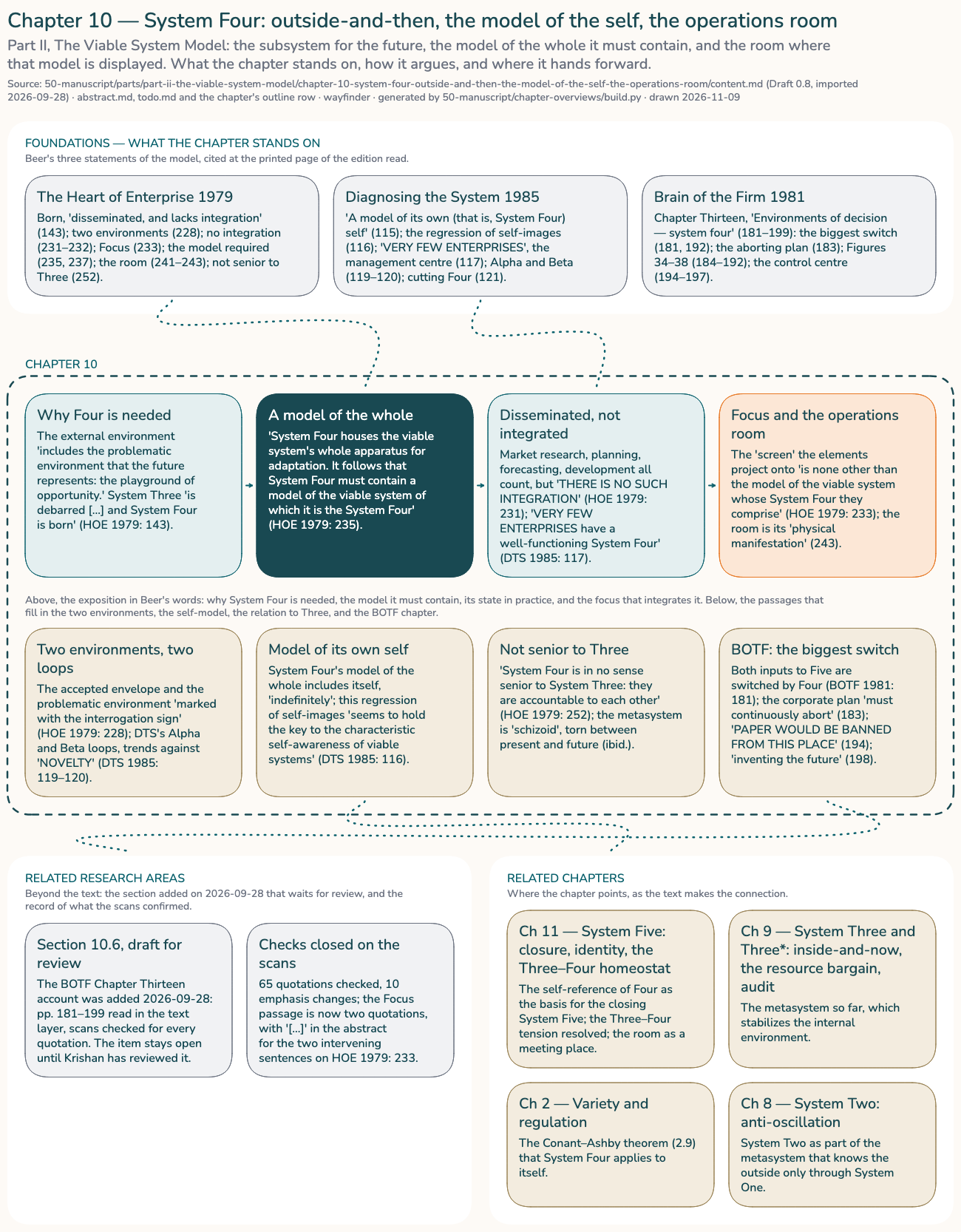
Ch 10 — System Four: outside-and-then, the model of the self, the operations room
Part II — The Viable System Model. The system that faces outward and forward: why the model needs one, what it must contain, and why Beer thinks practice supplies it least.
The question
What does Beer require of System Four — and why does he call it the weakest component of the viable system as organizations actually run it?
The reading
System Four is born out of what System Three cannot do. The environment of a viable system includes the problematic environment that the future represents — the playground of opportunity — and since System Three is dedicated to the internal environment, a system within the metasystem must deal with it (HOE 1979: 143). Diagnosing the System for Organizations adds the second task: System Four is not only concerned to manage the outside-and-then but to provide self-awareness for the System-in-focus (DTS 1985: 115). Beer distinguishes the accepted environment, the total envelope, from the problematic one; System Four both contains environmental variety and generates it (HOE 1979: 228, 237).
What it must contain follows from the Conant–Ashby theorem of chapter 2. Because System Four houses the whole apparatus for adaptation, it must contain a model of the viable system of which it is the System Four — and in current practice that model is held in the heads of senior people, is not made explicit, and cannot be interrogated or tested (HOE 1979: 235, 237). The recursion does not stop: System Four contains a model of itself, and that model contains a model of itself, indefinitely, and it is this infinite regression of self-images that Beer takes to hold the key to self-awareness (DTS 1985: 116).
Practice is where the argument bites. System Four is “the weakest component of the viable system in existing management orthodoxy”: it exists, has to exist, but is disseminated and lacks integration (HOE 1979: 143). Its activities are real — market research, corporate planning, economic forecasting, management development all count — but they are disparate, are active all over the organization in the cause of special pleading, and “it is quite normal” for its elements to know nothing of each other’s work (HOE 1979: 231–32). Under threat, enterprises cut System Four first, which Beer calls suicidal on the face of it (DTS 1985: 121).
His answer is not to merge those activities into one department — that would proliferate variety no management could handle — but Focus: all elements project their activities onto the same screen, and the screen is the model of the viable system whose System Four they comprise (HOE 1979: 233). Its physical form is the operations room, “the physical manifestation of our focus”, built for Allende in Santiago; at best, DTS says, a management centre (HOE 1979: 242–43; DTS 1985: 117). And System Four is in no sense senior to System Three: they are accountable to each other for the variety each disposes (HOE 1979: 252).
Beer locators
BOTF 1981: 181–99; DTS 1985: 115–17, 121; HOE 1979: 143, 228, 231–37, 241–43, 252.
Status
Draft, Pure VSM v0.8 (2026-09-23). Beer’s texts govern where the draft and they differ.
Checked: BOTF chapter 13 (“Environments of decision”, 181–99) was read in full for §10.6 and the scans checked for every quotation there.
Open points
- The BOTF treatment of System Four was added as §10.6 for review and stays open until Krishan has read it. Status of System Two and the wording of the Recursive System Theorem, which chapters 4 and 8 turn on, are recorded there.
Related
Part II — The Viable System Model, Ch 9 — System Three and Three*, Ch 11 — System Five, System Four, System Three, Viability, identity and autonomy, The Heart of Enterprise, Brain of the Firm, Diagnosing the System for Organizations, Cybersyn.