Chapter content · Overview diagram
Ch 18 — The Test That Could Not Lose
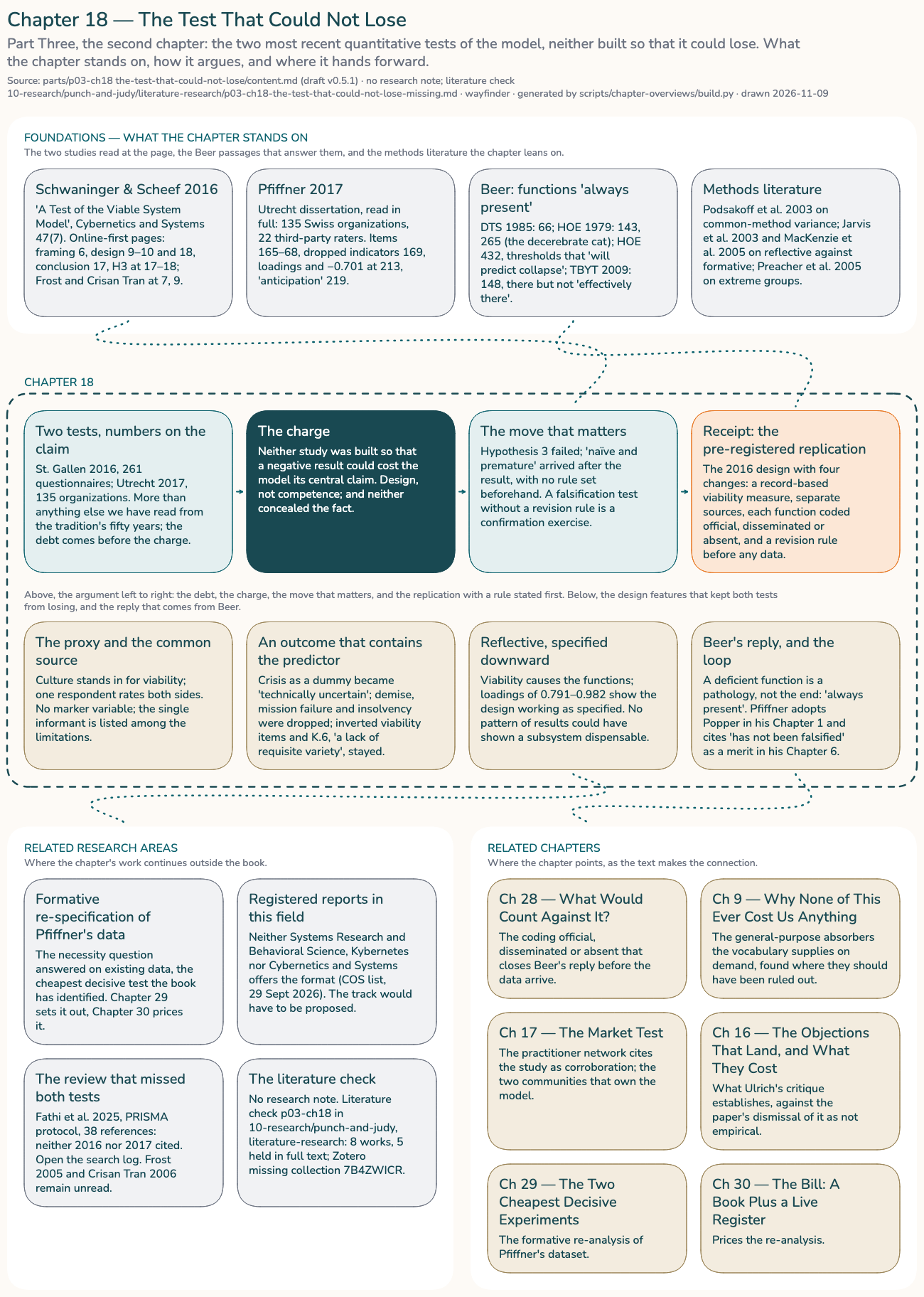
Part III — False friends and enemies. The chapter argues that the two most recent quantitative tests of the model — the 2016 St. Gallen survey and Pfiffner’s 2017 Utrecht dissertation — were both built so that a negative result could not cost the model its central claim, and that neither study concealed the fact.
The question
What happens when the one group that did put numbers on the model’s central claim builds a test that cannot lose?
The finding
The chapter credits both studies with doing more with numbers than anything else it read in the tradition’s fifty years, and states its charge as one of design, not competence. It also corrects its own earlier draft: the 2016 study was not the first attempt, and the two earlier St. Gallen dissertations were learned of only from the 2016 paper’s own review.
In the 2016 test, viability is proxied by organizational culture, both sides are rated by the same respondents, and no test for common-method variance is reported. Of eight hypotheses, one concerning System Three is rejected with a negative coefficient; the paper calls it naïve and premature to conclude that the component is less important than theory postulates. The chapter’s objection is to the timing: those explanations arrived after the result, with no rule set beforehand saying what a rejected hypothesis would be allowed to cost, so they can absorb any future negative finding. A falsification test without a declared revision rule, it says, is a confirmation exercise in statistical dress.
In Pfiffner’s dissertation the chapter finds better design — 22 outsiders who mostly did not know the theory, raters separate from managers, an explicit definition of predictive — and a deeper problem. The final outcome construct combines the inverse of three viability items with three crisis items, while the dropped items were the record-based ones: demise, mission failure, insolvency. A predictor and its near-negation, requisite variety and its lack, stand on opposite sides of the same equation. The structural model is reflective, not formative, so uniform high loadings show the design working as specified rather than showing any function to be dispensable.
The chapter notes that Pfiffner adopts critical rationalism in his introduction and later cites the absence of a falsification as a point in the model’s favour, and that a 2025 systematic review cites neither test. It concedes freely that no better-designed study need falsify the model.
What the chapter puts at risk
- Replicate the 2016 design with a record-based, independently sourced viability measure declared as an index of viability in Beer’s sense, not bare survival.
- Separate the sources for component ratings and outcome.
- Code each function as official, disseminated or absent, using indicators registered before fieldwork.
- Pre-register a revision rule naming which components, at what effect size, would be demoted from necessary to contributory.
Beer locators
DTS 1985: 66; HOE 1979: 143, 265, 432; TBYT 2009: 148.
Status
Draft, Punch and Judy v0.5.0 — not project canon, and not published. The chapter marks the two earlier dissertations as unread (known only from another paper’s summary) and says so; page numbers in the 2016 study are those of the online-first version. It concedes its charge against the earlier draft as “wrong twice over,” and states that it establishes no failure of the model.
Related
Punch and Judy — Overview, Viable System Model, Ch 17 — The Market Test, Ch 28 — What Would Count Against It?, Pathologies of viable systems, Observer and recognition