Chapter content · Overview diagram
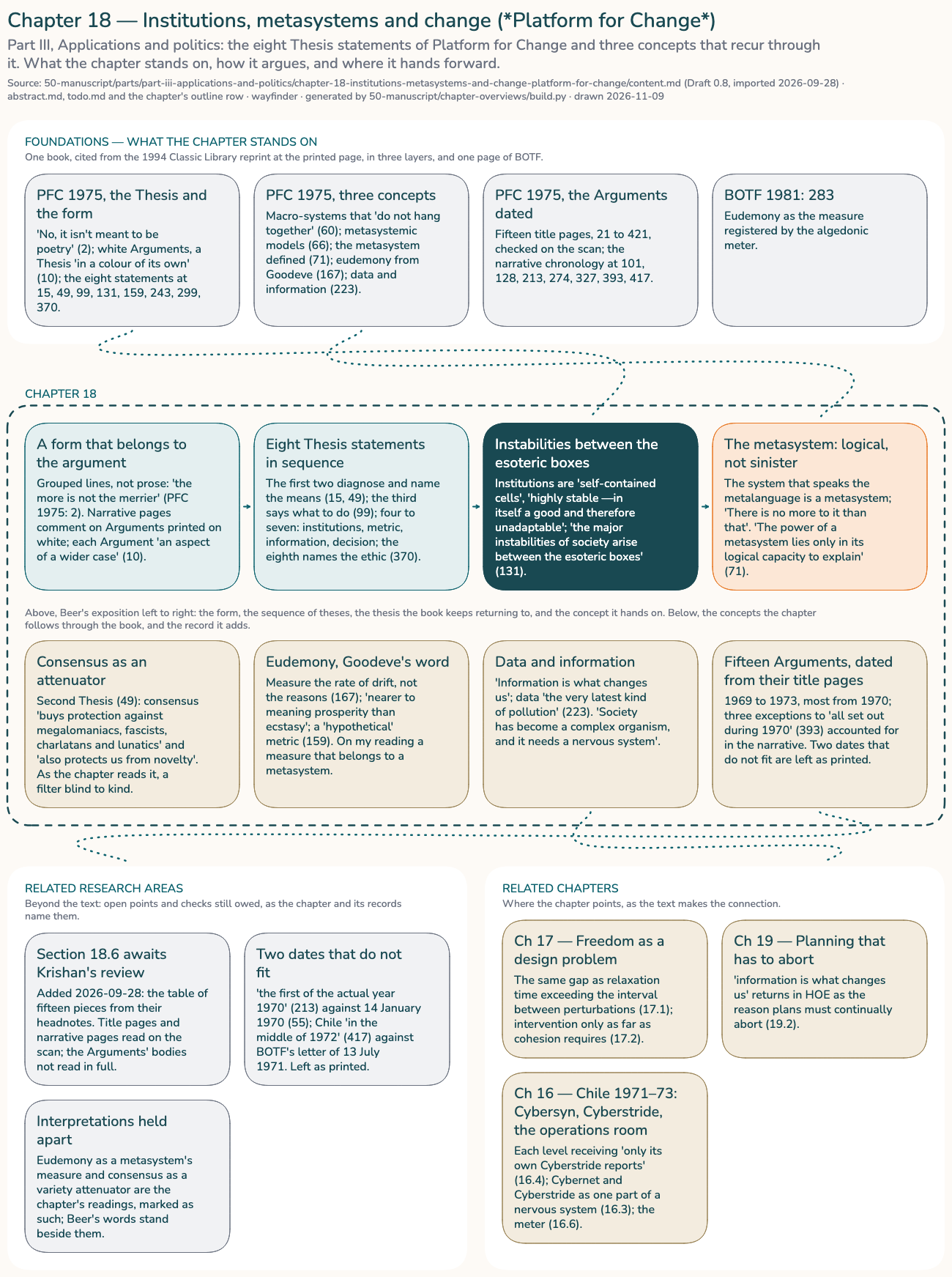
Ch 18 — Institutions, metasystems and change (Platform for Change)
Part III — Applications and politics. The social argument of the 1970s, taken from a book that is not written as prose: eight theses on why institutions resist change and what a cybernetics of society would need.
The question
Why do institutions resist the change their situation demands — and what would a cybernetics of society have to supply?
The reading
Platform for Change is built rather than written: grouped lines instead of prose to cut verbiage, narrative pages commenting on Arguments of Change that come from lectures and papers of 1969 to 1973, and the wider case stated in eight Thesis pages (PFC 1975: 2, 10). Those eight are the compact form of Beer’s social cybernetics of the period.
The first holds that man is a prisoner of his own way of thinking: complexity is the stuff of today’s world, the tool for handling it is organization, and our concepts of organization belong to a much less complex one (PFC 1975: 15). The second asks for science — mathematics, systems theory, cybernetics, behavioural science, operational research — in place of proceeding by consensus, which protects society from megalomaniacs and charlatans and equally from novelty, ability, change and leadership (49). The third names the order of work: think, reconstruct the language, then operate metasystemically, with continuous metasystemic monitoring (99). The fourth is the diagnosis of the box: institutions are self-contained cells, esoteric boxes difficult to penetrate, highly stable and therefore unadaptable, and separate reform of them will not reform society because the major instabilities arise between the boxes (131). The fifth draws the consequence that designing metasystems for such boxes requires a metric: money should be seen as the metric of constraint, and the hypothetical metric worth having is eudemony (159). The sixth makes it depend on information: how society handles information, which is what changes us, and data, its raw material, will prove critical even to the preservation of human freedom (243). The seventh asks for institutions with fast-responding, self-regulating, self-organizing decision dynamics — which dissolves the tired question of whether institutions should be centralized or decentralized, since any viable system is both — and names government as the institution most needing reform (299). The eighth states that change cannot occur within the existing ethic: mankind needs a new ethic, based on a true rather than spurious compassion, in a world where technology makes us unimaginably wealthy and that wealth is largely consumed by massive waste (370).
Two definitions do work across the book. The metasystem is introduced through the metalanguage: where a system’s undecidable propositions can be discussed only in a metalanguage, the system that speaks it is a metasystem, and there is no more to it than that (PFC 1975: 71); integration needs models drawn at the level of integration, and its absence shows as macro-systems that do not hang together while the interaction of micro-systems is self-defeating (60, 66). And eudemony, taken from Sir Charles Goodeve, is one of the Greek words for happiness but comes nearer to prosperity than to ecstasy (167) — it returns as the measure behind the algedonic meter (BOTF 1981: 283). The purpose of it all is regulation, which means translating data into information: information is what changes us, and data are the very latest kind of pollution (PFC 1975: 223).
Beer locators
BOTF 1981: 283; PFC 1975: 2, 10, 15, 49, 60, 66, 71, 99, 131, 159, 167, 223, 243, 299, 370.
Status
Draft, Pure VSM v0.8 (2026-09-23). Beer’s texts govern where the draft and they differ.
Checked: the title pages of the fifteen pieces were read on the scans, the narrative pages and the Reader’s Guide in the text layer. §18.1 was corrected accordingly — the Arguments run from 1969 to 1973, most of them from 1970.
Open points
- §18.6, a table of the fifteen pieces with dates and occasions, was added as an item for review. It records only what the book states, and it exposes two dates that do not fit: “the first of the actual year 1970” (213) against the 14 January 1970 ORS address (55), and Chile “in the middle of 1972” (417) against the letter of 13 July 1971 in Brain of the Firm.
- The bodies of the Arguments were not read in full; the table rests on their title-page headnotes.
Related
Part III — Applications and politics, Ch 17 — Freedom as a design problem, Ch 19 — Planning that has to abort, Platform for Change, Pathologies of viable systems, Viability, identity and autonomy, Algedonic signal, Stafford Beer.