Chapter content · Overview diagram
Ch 25 — The Transducer
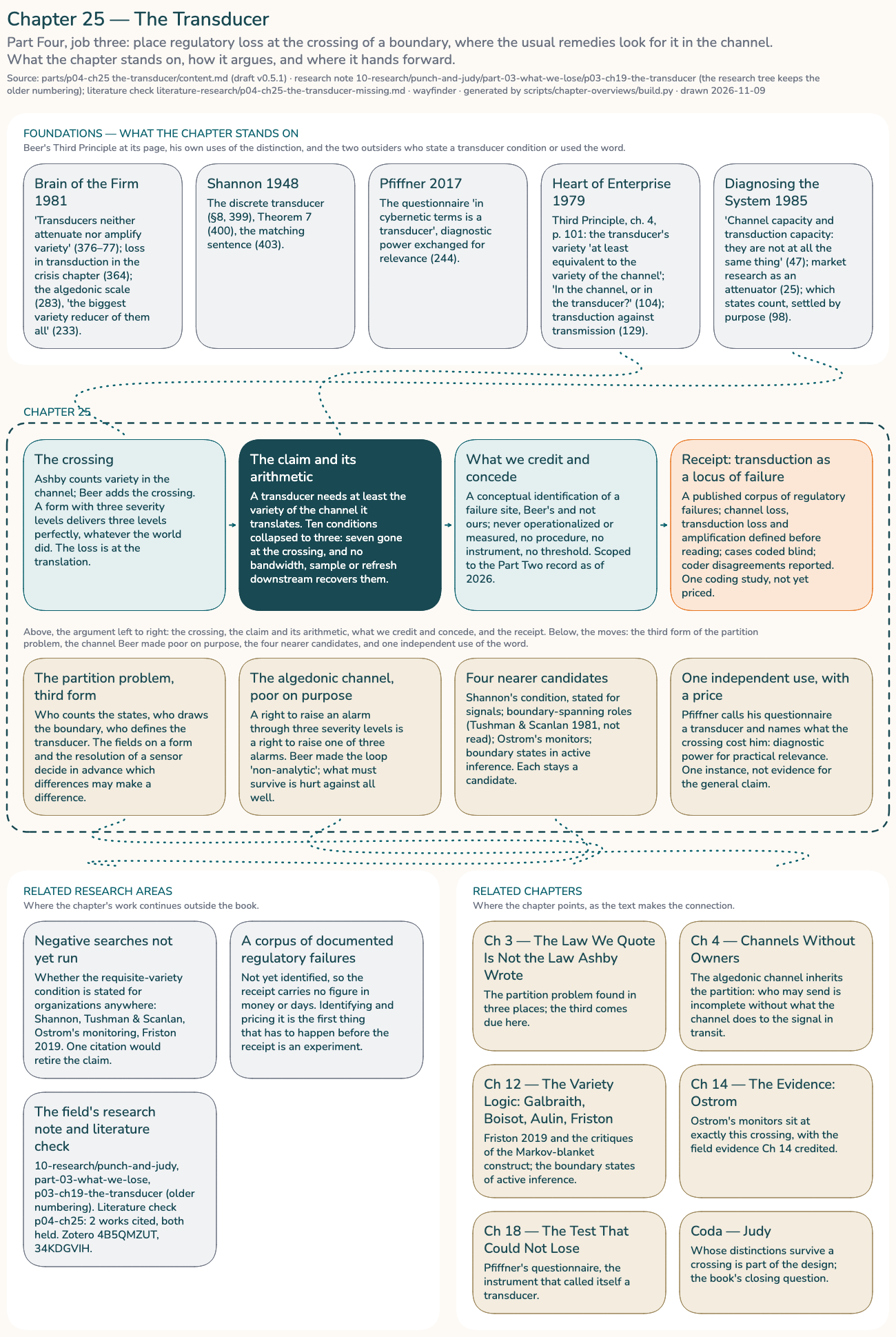
Part IV — What we lose. The chapter argues that regulatory failure often sits at the crossing of a boundary — where a transducer renders distinctions from one side into terms the other can receive — rather than in the channel, and that this principle of Beer’s has never been measured.
The question
Where does regulatory loss occur — in the channel, or at the crossing?
The finding
The chapter argues that Ashby counts variety in the channel, and Beer adds the crossing: information that crosses a boundary has to be translated, and a channel can carry every signal faithfully while the translation has already erased the distinction that mattered. The consequences are drawn arithmetically — if a channel distinguishes ten conditions and the translation collapses them into three, seven distinctions are gone, and no downstream bandwidth, sample size or refresh rate restores them. The principle has teeth: the ordinary remedy for a regulator that seems not to know what is happening (more reporting, more bandwidth, one more dashboard) can be exactly the wrong intervention, because it spends money and attention, produces a visible response, and leaves the site of the loss untouched. The chapter names the transducer as the third form of the partition problem — who counts the states, who draws the boundary, who defines the transducer — and notes that the algedonic channel inherits it, since a right to raise an alarm through a three-level form is a right to raise one of three alarms.
The concessions are substantial and stated beside the claim: the observation is Beer’s and is not presented as the authors’; the principle has never, to their knowledge, been operationalized or measured; there is no procedure for counting a transducer’s variety, no instrument, no threshold, and no published case in which the condition was measured. Beer’s own use of it in the crisis chapter of Brain of the Firm is, the chapter says, an explanation and not a count. What is credited is a conceptual identification of a failure site, not a validated measure.
The chapter names its nearer candidates one by one rather than gesturing at a literature: Shannon’s technical transducer, which is defined, measurable and quantitative and carries an analogous condition stated for signals; boundary-spanning roles (Tushman and Scanlan; not read); Ostrom’s monitoring; boundary states in active inference. It reports a gap in its own searching rather than a demonstrated absence, and scopes its claim to the Part Two record as it stands in 2026, not the literature at large — adding that a single citation would retire it. A small corroboration follows: Pfiffner, building his questionnaire, describes it as a transducer and states the cost of the crossing.
What the chapter puts at risk
Receipt — transduction as a locus of regulatory failure. Take a published corpus of documented regulatory failures; define in advance what counts as lost channel capacity and what counts as loss in transduction, with the definitions fixed before any case is read; code each case blind to the preferred explanation; code a second failure type, amplification at the crossing; report coder disagreements as well as counts. Two conditions would cost the claim its force: if failures do not concentrate at crossings, and if coders cannot distinguish crossing from channel without using VSM labels as their evidence. The chapter gives no figure in money or days, because it has not identified the corpus and cannot honestly price what it has not specified.
Beer locators
HOE 1979: 101 (Third Principle); BOTF 1981: 376–77; BOTF 1981: 364; DTS 1985: 47; HOE 1979: 104, 129; DTS 1985: 25, 98; BOTF 1981: 283, 233. Other sources: Shannon 1948 (§8, 399; Theorem 7, 400; 403); Tushman and Scanlan 1981; Friston 2019; Pfiffner 2017: 244.
Status
Draft, Punch and Judy v0.5.0 — not project canon, and not published. The chapter marks the principle as unmeasured, the search for another framework that joins organizational boundary crossing to a requisite-variety condition as incomplete, and the claim as scoped to the Part Two record rather than the literature.
Related
Punch and Judy — Overview · Variety and regulation · Algedonic signal · Observer and recognition · Brain of the Firm · The Heart of Enterprise · Ch 24 — Six Things Nothing Else Does