Chapter content · Overview diagram
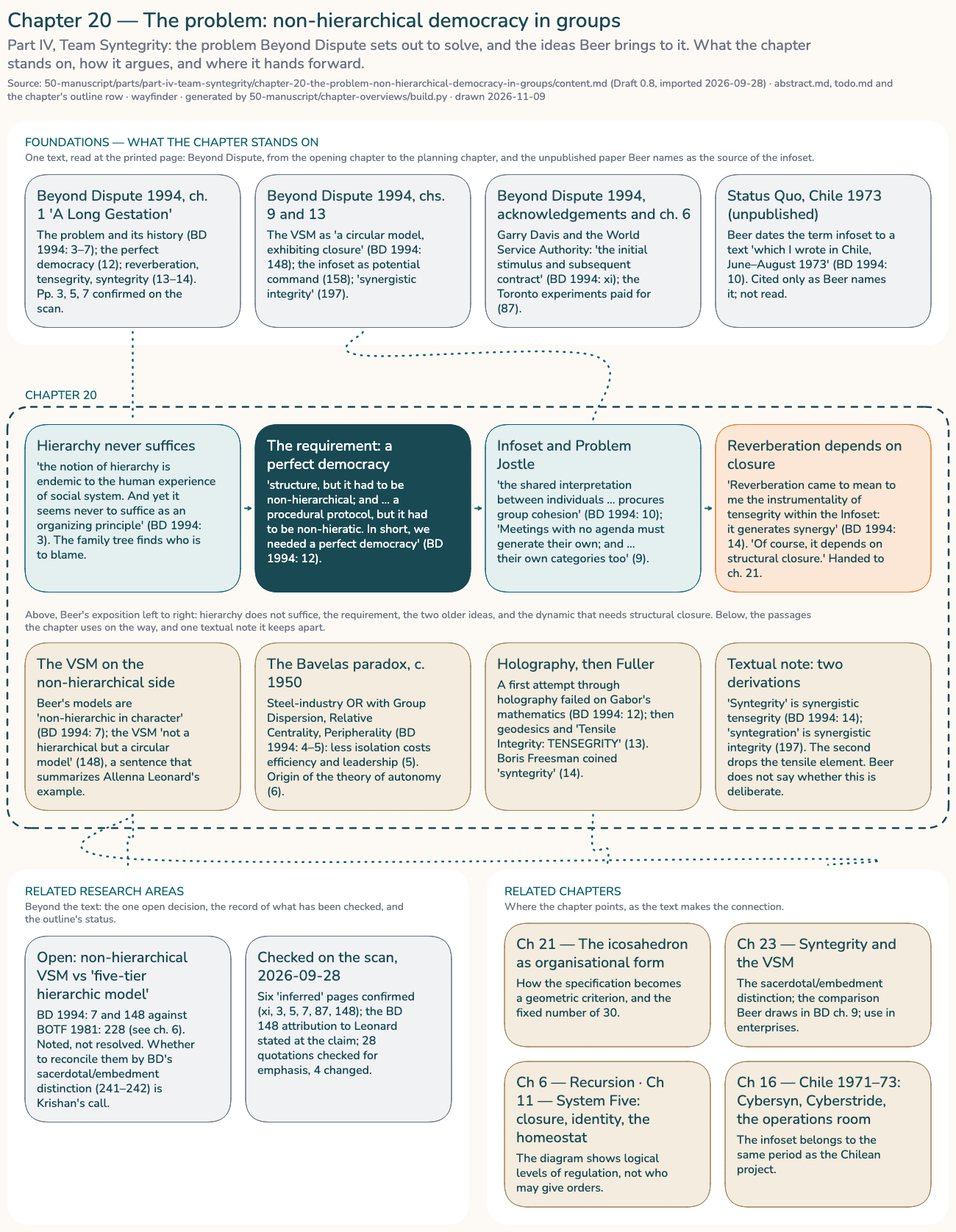
Ch 20 — The problem: non-hierarchical democracy in groups
Part IV — Team Syntegrity. The problem Team Syntegrity was built to solve: groups that must decide together without a hierarchy to decide for them.
The question
If hierarchy never suffices as an organizing principle, what structure would — and what does a group need in order to hold itself together?
The reading
Beer starts from an observation rather than a proposal. The notion of hierarchy is endemic to the human experience of social systems, and yet it seems never to suffice as an organizing principle (BD 1994: 3); the organization chart, in the same opening, is a mere instrument for discovering who is to blame (ibid.). Practical non-hierarchical solutions had existed — real and effective, but fairly pragmatic in design — and the book’s premise is that it might be advantageous to have a more rigorous theory (ibid.).
The Viable System Model belongs on the non-hierarchical side of that divide. Its models are built from interlocking homeostatic subsystems and are non-hierarchic for that reason, contrary to the critiques of rather casual readers (BD 1994: 7); and the VSM is not a hierarchical but a circular model, exhibiting closure because it includes its own environment in its organizational loops, its five subsystems so interactive that notions like top-down and bottom-up are as inappropriate in it as they are in the icosahedron (BD 1994: 148).
The design goal is then stated as a specification: the rest of us would need structure, but it had to be non-hierarchical, and a procedural protocol, but it had to be non-hieratic — in short, a perfect democracy (BD 1994: 12). Beer credits Garry Davis of the World Service Authority with the stimulus and the contract that turned the theory into action, and that Authority also supported the Toronto experiments (xi, 87).
Two of the concepts predate the book by decades. The infoset rests on the finding that it is shared interpretation between individuals that procures group cohesion; the term comes from an unpublished text, Status Quo, written in Chile in the summer of 1973 (BD 1994: 10). The Problem Jostle starts from the demand that meetings with no agenda must generate their own, and their own categories too; early experiments ran in the 1970s, including at the Silver Jubilee Meeting of the Society for General Systems Research in 1979 (BD 1994: 9).
The book’s third concept is what happens inside a closed group: an idea propagated at one node bounces round the others and returns, somewhat modified, to hit its progenitors on the back of the neck (BD 1994: 13). Beer links that reverberation to Fuller’s tensegrity — it is the instrumentality of tensegrity within the infoset, and it generates synergy — and since Fuller’s term was in commercial use, Boris Freesman coined syntegrity, drawing together synergistic tensegrity (BD 1994: 13–14).
Beer locators
BD 1994: 3, 7, 9–10, 12–14, 29, 74, 87, 114, 129, 148, 197, 241–42; BOTF 1981: 228.
Status
Draft, Pure VSM v0.8 (2026-09-23). Beer’s texts govern where the draft and they differ.
Checked: both BD passages on the non-hierarchical reading (7, 148) were confirmed against the scans, as was BOTF 1981: 228.
Open points
- The claim that the VSM is non-hierarchical (BD 1994: 7, 148) sits uneasily with Brain of the Firm’s “five-tier hierarchic model” (BOTF 1981: 228, discussed in chapter 6). The tension is noted in the draft and not resolved; whether and where the book reconciles the two usages — for instance through BD’s sacerdotal and embedment distinction (241–42) — is a judgement to be made.
- The word is derived twice: “syntegrity” as synergistic tensegrity (14) and “syntegration” as synergistic integrity (197). The chapter records both rather than choosing.
Related
Part IV — Team Syntegrity, Ch 19 — Planning that has to abort, Ch 21 — The icosahedron as organisational form, Team Syntegrity, Recursion, Viable System Model, Beyond Dispute, Stafford Beer.